|
Introduction
Viral
hepatitis remains one of the leading causes of
infectious disease mortality worldwide. According
to the World Health Organization, an estimated 254
million people were living with chronic hepatitis
B virus (HBV) infection and 50 million with
hepatitis C virus (HCV) infection in 2022. These
infections resulted in 1.3 million deaths globally
that year — equivalent to tuberculosis mortality —
with HBV accounting for 83% and HCV for 17% of
hepatitis-related deaths. Every day, approximately
3,500 people die from viral hepatitis
complications (1,2).
India bears a
disproportionately high burden, with approximately
29–30 million individuals chronically infected
with HBV and 5.5 million with HCV, ranking the
country second globally in absolute number of
cases (3,4). National estimates indicate an
overall HBV seroprevalence of around 0.95% and HCV
prevalence of 0.32%, with notable regional
variations; higher rates are observed in rural
areas and tribal populations for HBV, and in
certain urban pockets for HCV (5). Transmission
continues primarily through unsafe injections,
contaminated blood products, high-risk behaviours,
and perinatal routes. Although universal childhood
HBV vaccination has contributed to declining new
infections in younger age groups, significant gaps
in infection control, awareness, and service
coverage persist (6).
Despite the
availability of a safe and effective HBV vaccine
and highly curative direct-acting antiviral
therapy for HCV, diagnosis and treatment rates in
India remain suboptimal. This slow progress has
placed the country off-track to achieve the World
Health Organization’s 2030 viral hepatitis
elimination targets (1). Tertiary care hospitals
serve as critical referral centres that capture a
wide spectrum of cases, including advanced liver
disease, and provide essential real-world data on
epidemiological trends, demographic patterns, and
co-infections.
Previous
hospital-based studies in India have documented
varying seroprevalence rates of HBV and HCV, often
showing male predominance and higher detection
among middle-aged adults. However, contemporary
data reflecting post-pandemic healthcare
utilisation, evolving risk profiles, and the
impact of the National Viral Hepatitis Control
Programme (launched in 2018) are limited,
particularly from the East Delhi region (7).
The present
retrospective study was conducted to evaluate the
trends in the epidemiology of HBV and HCV
infections among patients attending a tertiary
care government hospital in East Delhi over a
2-year period. By analysing seroprevalence rates,
demographic characteristics, age- and
gender-specific distributions, this study aims to
provide updated insights into the local disease
burden. Such information is vital for
strengthening targeted screening strategies,
optimising resource allocation, and supporting
evidence-based interventions under the National
Viral Hepatitis Control Programme to accelerate
progress toward viral hepatitis elimination in the
region.
Materials and Methods
This retrospective
observational study was conducted at the Virology
Laboratory, Department of Microbiology, University
College of Medical Sciences and Guru Teg Bahadur
Hospital, Delhi. Laboratory records over a
two-year period, from 1st January 2024 to 31st
December 2025, were systematically reviewed.
The study population
comprised patients attending outpatient services
or admitted to the hospital who underwent
serological testing either as part of routine
government-mandated screening or for diagnostic
evaluation.
Data pertaining to
enzyme-linked immunoassay results for Hepatitis B
surface antigen (HBsAg) and Hepatitis C virus
(HCV) antigen and/or anti-HCV antibodies were
extracted and analysed. Serological screening for
hepatitis B surface antigen (HBsAg) and
anti-hepatitis C virus (anti-HCV) antibodies was
performed using commercially available
enzyme-linked immunosorbent assay (ELISA)
kits—HEPALISA (HBsAg) and MICROLISA anti-HCV (J.
Mitra & Co. Pvt. Ltd., India)—in accordance
with the manufacturer’s instructions.
Both assays are
third generation Elisa, based on the solid-phase
ELISA principle employing microwells coated with
specific monoclonal antibodies or antigens. Serum
or plasma samples were added to the wells and
incubated with enzyme-labelled conjugates,
facilitating the formation of antigen–antibody
complexes in reactive samples. Following washing
steps to remove unbound material, a chromogenic
substrate was added, resulting in a colorimetric
reaction proportional to the presence of target
analyte. The optical density (OD) was measured at
450 nm using an ELISA reader. Results were
interpreted as reactive or non-reactive based on
the assay-specific cut-off values as defined by
the manufacturer.
For screening
purposes, the detection of HBsAg and anti-HCV
antibodies was performed using the ELISA method,
the Patient data were extracted from the system in
Excel format. The following information was
collected for each patient: age, sex, HBsAg, and
anti-HCV Ab ELISA results. The analysis was
conducted exclusively on data provided for routine
laboratory investigations. No additional data were
extracted, and only variables documented as part
of standard diagnostic and reporting processes
were included in the study. Descriptive statistics
was utilized to summarize the study population
characteristics. Statistical analyses were done
with the SPSS 27.0 software, and p-values of
<0.05 were considered statistically
significant.
Results
During the study
period, a total of 63,616 samples were screened
for Hepatitis B and 50,951 samples for Hepatitis
C. Of these, 1,468 samples tested positive for
Hepatitis B (2.31%), while 2,426 samples were
positive for Hepatitis C (4.76%).
The overall HBsAg
positivity remained stable over the two-year
period, with 2.319% in 2024 and 2.296% in 2025
(Table 1). In contrast, Anti-HCV seropositivity
showed a slight increase from 4.526% in 2024 to
5.078% in 2025 (Table 2).
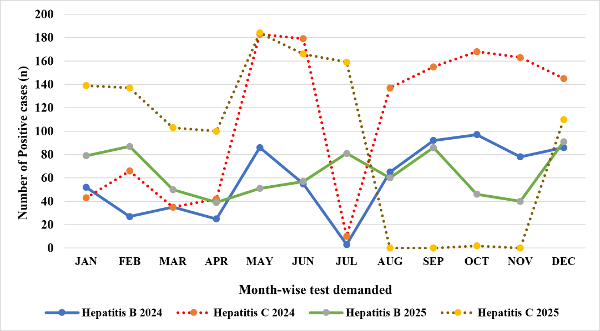
The monthly
distribution of cases demonstrated distinct
temporal patterns (Figure 1). Hepatitis B cases
showed moderate fluctuations across both years,
with a peak in October 2024 (97 cases) and a
secondary rise in December 2025 (91 cases). In
contrast, Hepatitis C exhibited greater
variability, with a pronounced peak in May of both
years (183 and 184 cases), along with elevated
numbers during June–July, followed by a marked
decline in the latter half of 2025.
Gender-wise analysis
revealed a marked male predominance in both
infections (Figure 2). Among Hepatitis B cases,
1001 (68.2%) were males and 467 (31.8%) were
females (male: female = 2:1). In Hepatitis C, 1886
(77.7%) cases were males and 540 (22.3%) were
females (male: female = 3:1). The difference in
gender distribution between the two infections was
statistically highly significant (p < 0.00001).
Age-stratified
analysis demonstrated that the majority of cases
were observed in younger age groups (Figure 3).
The 21–40 years age group accounted for the
highest proportion, followed by the 41–60 years
group, while paediatric (0–20 years) and elderly
(≥61 years) populations contributed relatively
smaller proportions.
Analysis based on
indication for testing showed differing patterns
between the two infections (Figure 4). Given the
paucity of clinical background data available with
the laboratory, a presumptive grouping was
attempted to understand the demand for testing
from different clinical departments. Therefore,
the authors grouped the dataset with the following
groups.
Group 1, comprising
symptomatic patients from the Department of
Medicine; Group 2, antenatal screening cases from
the ANC clinic; Group 3, individuals undergoing
pre-operative screening across surgical
specialties, including General Surgery,
Orthopaedics, and ENT; and Group 4, patients
attending the ART clinic. This systematic
stratification reflects the diverse clinical
settings in which hepatitis screening is
undertaken and enables a more robust and nuanced
interpretation of disease distribution across
heterogeneous patient populations.
Among hepatitis B
cases, the highest proportion was observed among
symptomatic patients referred from the Department
of Medicine, followed by individuals attending the
ART clinic and those undergoing pre-operative
screening, with a minimal contribution from
antenatal screening. In contrast, hepatitis C
cases were predominantly identified among ART
clinic attendees, followed by symptomatic patients
and individuals screened pre-operatively across
various surgical specialties. Notably, the
majority of these cases were derived from
outpatient services, reflecting the predominance
of routine screening and follow-up evaluations in
the outpatient setting.
|
Table 1: Prevalence of HBsAg
Positivity Among Tested Samples
(2024–2025)
|
|
Year
|
Total Samples Received
|
HBsAg Positive Samples
|
% Positive
|
|
2024
|
30,221
|
701
|
2.319%
|
|
2025
|
33,395
|
767
|
2.296%
|
|
Total
|
63,616
|
1468
|
2.307%
|
|
Table 2: Year-wise Distribution
of Anti-HCV Seropositivity (2024–2025)
|
|
Year
|
Total Samples Received
|
Anti-HCV Positive Samples
|
% Positive
|
|
2024
|
29,291
|
1326
|
4.526%
|
|
2025
|
21,660
|
1100
|
5.078%
|
|
Total
|
50,951
|
2426
|
4.76%
|
|
| Figure
1: Monthly distribution of Hepatitis B
(solid lines) and Hepatitis C (dotted
lines) positive cases in 2024 and 2025.
|
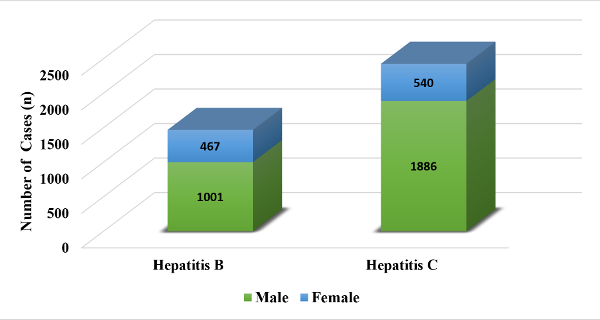
|
| Figure 2: Comparison
of gender distribution in Hepatitis B and
C cases (n). |
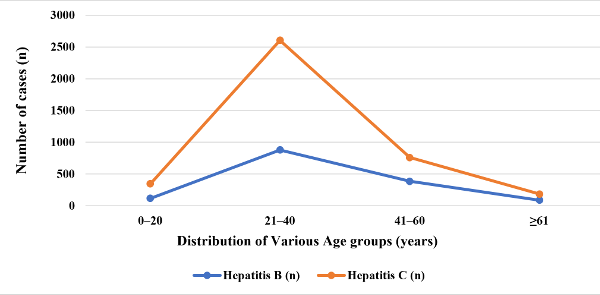
|
| Figure 3:
Age-stratified Trends in Hepatitis B and
Hepatitis C cases (n) |
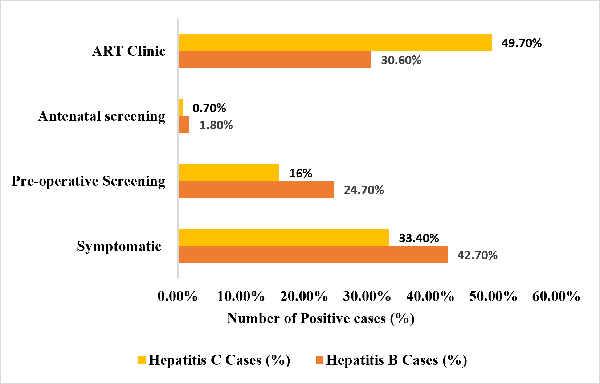
|
| Figure 4: Comparative
Distribution of Hepatitis B and Hepatitis
C by Indication for Testing (%) |
Discussion
The present study
provides a comprehensive evaluation of the
Sero-epidemiological trends of Hepatitis B and
Hepatitis C infections in a tertiary care hospital
setting in East Delhi. The large sample size and
inclusion of both outpatient and inpatient
populations strengthen the reliability of the
findings and reflect real-world disease burden in
an urban North Indian healthcare setting.
The overall
seroprevalence of Hepatitis B (2.31%) observed in
this study falls within the intermediate
endemicity range reported for India (2–4%) (8,9).
This finding is consistent with several
hospital-based and community-based studies
conducted across the country, indicating a
relatively stable burden of HBV infection. In
contrast, the seropositivity of Hepatitis C
(4.76%) is notably higher than national estimates,
which range between 0.3% and 1% (10,11). This
discrepancy may be attributed to the tertiary care
nature of the study setting, where a higher
proportion of high-risk individuals, including
those attending ART clinics and those undergoing
diagnostic workups, are represented.
A key observation of
this study is the stable trend in Hepatitis B
positivity over the two-year period. This plateau
likely reflects the cumulative impact of public
health interventions, including universal
immunization, improved blood transfusion safety,
and increased awareness (12,13). Similar
stabilization trends have been documented in
recent Indian studies, particularly among younger
populations benefiting from vaccination programs.
However, the persistence of HBV infection
highlights ongoing transmission in unvaccinated
adults and the need for expanded screening and
immunization strategies.
In contrast,
Hepatitis C demonstrated a relatively higher and
slightly increasing trend, suggesting ongoing
transmission dynamics. This is in agreement with
recent studies that emphasize the role of unsafe
injections, invasive procedures, and high-risk
behaviours in sustaining HCV transmission in
developing countries (14,15). The predominance of
HCV cases among ART clinic attendees in the
present study further supports the established
association between HCV infection and high-risk
populations, including individuals with HIV
infection and people who inject drugs.
Temporal analysis in
this study did not reveal a consistent seasonal
pattern for Hepatitis B, whereas Hepatitis C
showed clustering during mid-year months. Such
variations are unlikely to represent true
seasonality and may instead reflect fluctuations
in healthcare utilization, targeted screening
activities, or episodic exposure risks (16).
The male
predominance observed in both infections,
particularly in Hepatitis C (male: female ratio of
3:1), is consistent with previous Indian and
global studies (14,17). This pattern may be
explained by increased exposure to occupational
hazards, higher likelihood of high-risk
behaviours, and gender-related differences in
healthcare-seeking behaviour.
Age-wise
distribution revealed that the 21–40 years age
group accounted for the highest proportion of
cases, followed by the 41–60 years group. This
trend is consistent with existing epidemiological
evidence and reflects increased exposure to risk
factors during the most active years of life
(18,19). The relatively lower burden in paediatric
populations supports the success of hepatitis B
vaccination programs, whereas the lower proportion
in elderly individuals may reflect under-screening
or survivor bias.
An important finding
of this study is the high proportion of
asymptomatic cases, particularly for Hepatitis B,
indicating that a substantial number of infections
remain undiagnosed until detected incidentally.
This observation aligns with previous studies
emphasizing the silent nature of viral hepatitis
and the importance of opportunistic screening
(20,21).
The higher
contribution of cases from departments such as
Medicine and ART clinics further highlights the
importance of integrated screening strategies
within hospital settings, especially for high-risk
populations. Opportunistic testing in such
settings plays a critical role in early diagnosis
and prevention of disease progression.
Recognizing the
critical role of surveillance in achieving
hepatitis elimination, the Government of India has
placed strong emphasis on strengthening
surveillance systems under the National Viral
Hepatitis Control Program, launched on 28 July
2018 in alignment with World Health Organization
targets for 2030 (20). Implemented under the
Ministry of Health and Family Welfare, the program
provides free screening, diagnosis, and treatment,
supported by a nationwide network of laboratories
enabling standardized testing, systematic data
collection, and robust reporting (22). Despite
these efforts, challenges such as low diagnosis
rates, limited access to advanced diagnostics,
regional disparities, and suboptimal birth-dose
vaccination continue to impede progress toward
elimination goals (23).
In conclusion, the
study demonstrates a stable endemic pattern of
Hepatitis B alongside a relatively higher and
evolving burden of Hepatitis C, particularly among
high-risk populations. These findings underscore
the need for strengthening targeted screening
programs, improving access to antiviral therapy,
and reinforcing infection control measures.
Continuous surveillance and region-specific
epidemiological data are essential to guide public
health strategies and achieve the goal of viral
hepatitis elimination.
Despite its
strengths, this study has certain limitations.
Being retrospective and hospital-based, the
findings may not be fully generalizable to the
broader community. Additionally, lack of detailed
risk factor assessment and follow-up data limits
causal inference and long-term outcome analysis.
References
- World Health Organization. Global hepatitis
report 2024: action for access in low- and
middle-income countries. Geneva: World Health
Organization; 2024.
- World Health Organization. WHO sounds alarm on
viral hepatitis infections claiming 3500 lives
each day [Internet]. Geneva: World Health
Organization; 2024 Apr 9 [cited 2026 Mar 31].
- Polaris Observatory Collaborators. Global
prevalence, treatment, and prevention of
hepatitis B virus infection in 2016: a modelling
study. Lancet Gastroenterol Hepatol.
2017;2(6):383–403.
- Shanmugam V, Ward J, Vijayakumar S et al.
Challenges and opportunities in combating viral
hepatitis in India: insights from the Indian
Hepatitis Summit 2025. BMC Proc
2026;20(Suppl 4):4.
https://doi.org/10.1186/s12919-025-00358-w
- Jasrotia A, Revanuru H, Kar P, Chadha A.
Changing epidemiology of viral hepatitis in
India: regional variations and public health
implications. Trop Gastroenterol. 2025;46(4):141-146
- Swaroop S, Shalimar, Acharya SK. Hepatitis B
virus prevalence in India: A wake-up call for
action. Indian J Gastroenterol. 2025
Oct;44(5):585-587. doi:
10.1007/s12664-025-01804-5.
- Singh S, et al. Seroprevalence and risk
factors of hepatitis B and C in a tertiary care
setting in North India. Indian J Med Microbiol.
2025.
- Batham A, Narula D, Toteja T, Sreenivas V,
Puliyel JM. Systematic review and meta-analysis
of prevalence of hepatitis B in India. Indian
Pediatr. 2007;44(9):663–674.
- Murhekar MV, et al. Viral hepatitis in India:
past, present, and future. J Clin Exp
Hepatol. 2021;11(4):389–400.
- Goel A, Seguy N, Aggarwal R. Burden of
hepatitis C virus infection in India: A
systematic review. J Gastroenterol Hepatol.
2019;34(2):321–329.
- World Health Organization. Global hepatitis
report 2024. Geneva: WHO; 2024.
- Schweitzer A, Horn J, Mikolajczyk RT, Krause
G, Ott JJ. Estimations of worldwide prevalence
of chronic hepatitis B virus infection. Lancet.
2015;386(10003):1546–1555.
- Government of India. National Viral Hepatitis
Control Programme: Operational Guidelines. New
Delhi: Ministry of Health and Family Welfare;
2018.
- Solomon SS, Mehta SH, Srikrishnan AK, et al.
High prevalence of hepatitis C among people who
inject drugs in India. Clin Infect Dis.
2015;61(4):597–603.
- Degenhardt L, Peacock A, Colledge S, et al.
Global prevalence of injecting drug use and HCV.
Lancet Glob Health.
2017;5(12):e1192–e1207.
- Alter MJ. Epidemiology of viral hepatitis and
HIV co-infection. J Hepatol.
2006;44(S1):S6–S9.
- Prasad M, et al. Seroprevalence and risk
factors of hepatitis B and C infections. J
Clin Diagn Res. 2016;10(6):DC09–DC12.
- Polaris Observatory Collaborators. Global
prevalence and genotype distribution of HBV. Lancet
Gastroenterol Hepatol. 2017;2(3):161–176.
- Nayagam S, Thursz M, Sicuri E, et al.
Requirements for global elimination of hepatitis
B. Lancet Infect Dis.
2016;16(12):1399–1408.
- World Health Organization. Global health
sector strategy on viral hepatitis 2022–2030.
Geneva: WHO; 2022.
- Chaturvedi N, et al. Epidemiology of
bloodstream infections and viral hepatitis in
India. Indian J Med Microbiol.
2021;39(1):1–6.
- Puri P, Anand AC, Saraswat VA, et al. The
National Viral Hepatitis Control Program in
India: current status and future directions. J
Clin Exp Hepatol. 2021;11(6):755–764.
- Gupta E, Puri P, Kumar A, et al. Fast pacing
India’s fight against viral hepatitis: progress
and challenges. Indian J Med Res. 2025.
|


