|
Introduction
Gallstone
disease is a common surgical problem in India,
with reported prevalence ranging from 2% to 29%
across regions; North Indian populations show a 2-
to 4-fold higher prevalence than South Indian
populations, a difference attributed to diet,
lifestyle, and environmental factors, with
cholesterol stones predominating in the north and
pigment stones in the south [1]. The disease
predominantly affects adults aged 40-50 years,
although its incidence in younger patients is
rising, and women are affected 2- to 3-fold more
often than men [1].
Laparoscopic
cholecystectomy (LC) is the gold-standard
treatment for symptomatic cholelithiasis, offering
reduced postoperative pain, shorter
hospitalisation, and faster return to activity
compared with open surgery. Safe completion of LC
depends on achieving the critical view of safety
during dissection of the hepatocystic triangle
[2]. Despite widespread adoption and technical
refinement, operative difficulty remains highly
variable: a subset of patients requires prolonged
dissection, conversion to open surgery, or is at
elevated risk of bile duct injury, particularly in
the setting of dense adhesions, a contracted or
severely inflamed gallbladder, or an obscured
Calot triangle.
The Parkland Grading
Scale (PGS) was developed as a simple,
reproducible, intraoperative five-tier scale
(grade 1, minimal inflammation, through grade 5,
severe inflammation with adhesions obscuring
anatomy) based on the initial laparoscopic view of
the gallbladder, and has been prospectively
validated with good inter-rater reliability and
correlation with operative time, conversion, and
bile leak rates [3,4]. Because PGS is by
definition an intraoperative assessment, it cannot
itself inform preoperative planning; several
groups have therefore proposed preoperative
scoring systems (for example, the Randhawa and
Pujahari score, incorporating age, sex, prior
hospitalisation, body mass index (BMI), abdominal
scars, palpable gallbladder, ultrasonographic
(USG) wall thickness, pericholecystic fluid, and
impacted stones) intended to anticipate a
difficult LC before the patient reaches the
operating table [5]. USG gallbladder wall
thickening, BMI, prior acute cholecystitis, and
inflammatory markers such as C-reactive protein
(CRP) and the neutrophil:lymphocyte ratio (NLR)
have variably been reported as independent
predictors of a difficult or prolonged
cholecystectomy in the surgical literature [6-9].
Despite this body of
work, the relative and independent contribution of
routinely available preoperative clinical,
haematological, biochemical, and radiological
parameters to intraoperative difficulty, graded
objectively using PGS, has not been
comprehensively examined in an Indian
tertiary-referral population. We therefore
conducted this prospective observational study to
evaluate the association between preoperative
clinical, haematological, biochemical, and
radiological parameters and intraoperative
severity as graded by PGS in patients undergoing
LC for symptomatic cholelithiasis, with the aim of
identifying parameters that could support
preoperative risk stratification.
Methods
Study Design and Sample Size
This was a
prospective, single-centre, observational study
conducted in the Department of Surgical
Gastroenterology and Liver Transplantation,
Bangalore Medical College and Research
Institute-Super Speciality Hospital (BMCRI-SSH,
PMSSY), Bengaluru, India, over the period January
2025 to June 2026. A formal a priori sample size
calculation was not performed. The study was
designed as an exploratory prospective
observational investigation, and all eligible
patients presenting during the study period were
consecutively enrolled. [10]
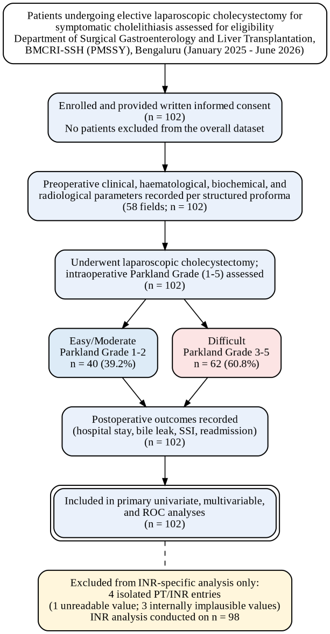
|
| Flow
diagram 1: STROBE-style flow diagram of
participant enrolment, data collection,
and analysis (N=102) |
Participants
Consecutive adult
patients with symptomatic cholelithiasis scheduled
for elective LC at the study centre during the
study period were considered for enrolment. All
patients who provided informed consent and
completed preoperative work-up and LC during the
study period were included in the analysis; no
patient was excluded from the overall dataset.
Variables
Preoperative
variables recorded were: demographic (age, sex,
weight, height, BMI, duration of symptoms),
clinical history (prior cholecystitis, history of
cholangitis, history of biliary pancreatitis,
comorbidities), vital signs (temperature, pulse,
systolic and diastolic blood pressure, respiratory
rate), general examination findings (pallor,
icterus, palpable gallbladder, abdominal scar),
haematological indices (haemoglobin, packed cell
volume, total leucocyte count, differential
neutrophil and lymphocyte percentage, platelet
count, neutrophil:lymphocyte ratio), biochemical
parameters (total, direct and indirect bilirubin,
total protein, albumin, globulin, albumin:globulin
ratio, alkaline phosphatase, alanine
aminotransferase, aspartate aminotransferase,
gamma-glutamyl transferase, C-reactive protein,
prothrombin time and INR), and radiological
findings (USG gallbladder wall thickness, impacted
cystic duct/neck stone, pericholecystic fluid,
distended gallbladder, and use of
contrast-enhanced CT abdomen and/or magnetic
resonance cholangiopancreatography). The primary
outcome was intraoperative operative difficulty,
graded at surgery using the five-tier Parkland
Grading Scale [3]. Secondary intraoperative and
postoperative outcomes recorded were operative
time, conversion to open cholecystectomy, common
bile duct (CBD) injury, intraoperative drain
placement, intraoperative bile/stone spillage,
postoperative bile leak, surgical-site infection,
hospital stay, and readmission. In cases where the
Parkland Grade was not explicitly documented
intraoperatively by the operating surgeon, grading
was retrospectively assigned from operative
records using predefined Parkland Grading Scale
criteria. Data abstraction was performed during
study curation using operative findings documented
in the surgical notes
Statistical
Analysis
Statistical analyses
were performed using SPSS v.29 (IBM Corp., Armonk,
NY, USA). Continuous variables are summarised as
mean ± standard deviation and median
(interquartile range, IQR); distributional
normality was assessed using the Shapiro-Wilk
test. Given evidence of non-normality for several
skewed parameters, between-group comparisons
(Easy/Moderate versus Difficult) for continuous
variables were performed using the Mann-Whitney U
test, with the Kruskal-Wallis test used to compare
across all five Parkland grades. Categorical
variables are summarised as frequencies and
percentages and compared using the chi-square test
or Fisher exact test as appropriate for expected
cell counts. Receiver operating characteristic
curves and area under the curve (AUC) were
generated for all clinically relevant continuous
predictors. Optimal cut-off values were determined
using the Youden Index and AUC values were
reported with corresponding 95% confidence
intervals. A two-sided p<0.05 was considered
statistically significant throughout
Results
Participants
and descriptive data
Between January 2025
and June 2026, 102 patients undergoing LC for
symptomatic cholelithiasis were enrolled and
analysed; no patient was excluded from the overall
dataset. The cohort comprised 77 women (75.5%) and
25 men (24.5%) (female:male ≈ 3:1), with a mean
age of 45±14 years (median 45, IQR 35-55; range
20-81) and mean BMI of 24.7±2.8 kg/m² (range
20-30). Comorbidities were present in 29.4% of
patients (diabetes mellitus 13.7%, hypertension
8.8%, both 6.9%); median duration of symptoms was
9 weeks (IQR 4.1-17.8). Prior history of
cholecystitis was recorded in 15.7% and biliary
pancreatitis in 2.9%. CECT abdomen was performed
in 13.7% and MRCP in 17.6% of patients, consistent
with selective, second-line use of cross-sectional
imaging rather than routine practice.
Intraoperative
and postoperative outcomes
The intraoperative
Parkland Grade distribution was: grade 1 in 36
patients (35.3%), grade 2 in 4 (3.9%), grade 3 in
41 (40.2%), grade 4 in 20 (19.6%), and grade 5 in
1 (1.0%) (Figure 1). Using the pre-specified
dichotomisation, 40 patients (39.2%) were
classified as Easy/Moderate (grade 1-2) and 62
(60.8%) as Difficult (grade 3-5). No conversion to
open cholecystectomy, CBD injury, surgical-site
infection, or readmission occurred in this cohort
(0/102 each); one patient (1.0%) developed a
postoperative bile leak. Median hospital stay was
3 days (IQR 2-6).
Mean operative time
was 85±36 minutes, recorded in this cohort as one
of three standard theatre-time bands (45, 95, or
140 minutes); every Easy/Moderate case was
completed within the 45-minute band, while every
difficult case fell in the 95- or 140-minute band.
As operative time is an intraoperative measurement
rather than a preoperative one, it is reported
here as a correlate confirming the face validity
of the Parkland difficulty classification, rather
than as a preoperative predictor.
Univariate
associations with intraoperative difficulty
Table 1, summarises
baseline demographic and clinical characteristics
by difficulty category. Table 2, presents the
univariate comparison of continuous preoperative
parameters. Presence of any comorbidity (diabetes
and/or hypertension) was significantly associated
with a Difficult intraoperative course (χ²
p=0.015; Table 1), as were lower platelet count
(median 265 vs 309.5 ×10³/µL, p=0.037) and shorter
prothrombin time (median 11.65 vs 13.3 seconds,
p=0.008). No significant between-group difference
was found for age, height, duration of symptoms,
vital signs, haemoglobin, packed cell volume,
total leucocyte count, differential counts, CRP,
NLR, bilirubin fractions, total protein, albumin,
globulin, A:G ratio, or the
transaminase/cholestatic liver enzymes (all
p≥0.10; Table 2). Notably, CRP and NLR, both
classically reported as predictors of a difficult
cholecystectomy in the literature [9], did not
reach significance in this cohort (p=0.170 and
p=0.579 respectively). Categorical radiological
findings (USG impacted stone, pericholecystic
fluid, distended gallbladder) and
imaging-utilisation variables (CECT, MRCP
performed) were also not significantly associated
with difficulty grade (all p>0.10; Table
1). Previous abdominal scar showed a borderline
association (p=0.069), with infra- and
supra-umbilical scars more frequent in the
Difficult group. BMI and USG gallbladder wall
thickness showed complete separation between
groups (both AUC 1.00) and weight showed
near-complete separation (AUC 0.99); these three
variables are reported in Table 2 for the full
cohort and analysed separately as standalone
discriminators in Table 5, below, rather than
combined into the multivariable model with the
moderate-effect predictors (see Statistical
analysis).
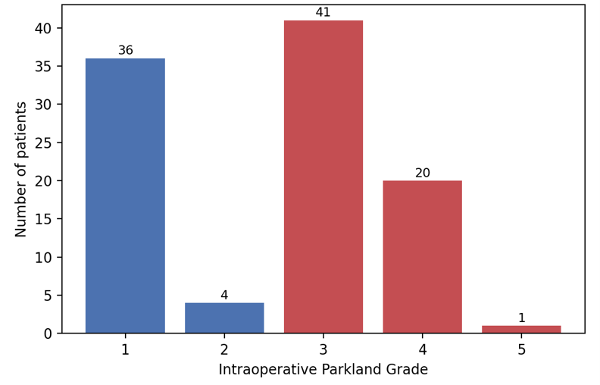
|
| Figure
1: Distribution of intraoperative Parkland
Grade (1-5) across the study cohort
(N=102). Grades 1-2 (blue) are classified
Easy/Moderate; grades 3-5 (red) are
classified Difficult. |
|
Table 1: Baseline categorical
characteristics and their association
with intraoperative Parkland difficulty
category (N=102).
|
|
Characteristic
|
Categories, n (%)
|
Test
|
p-value
|
|
Sex
|
F: 77 (75.5); M: 25 (24.5)
|
Chi-square
|
0.119
|
|
Prior history of cholecystitis
|
N: 86 (84.3); Y: 16 (15.7)
|
Chi-square
|
0.122
|
|
History of biliary pancreatitis
|
N: 99 (97.1); Y: 3 (2.9)
|
Fisher exact
|
1.000
|
|
Comorbidities
|
None: 72 (70.6); DM: 14 (13.7); HTN: 9
(8.8); DM+HTN: 7 (6.9)
|
Chi-square
|
0.015*
|
|
USG impacted cystic duct/neck
stone
|
N: 100 (98.0); Y: 2 (2.0)
|
Fisher exact
|
1.000
|
|
USG pericholecystic fluid
|
N: 98 (96.1); Y: 4 (3.9)
|
Fisher exact
|
0.153
|
|
USG distended gallbladder
|
N: 68 (66.7); Y: 34 (33.3)
|
Chi-square
|
0.351
|
|
Previous abdominal scar
|
None: 84 (82.4); Infra-umbilical: 16
(15.7); Supra-umbilical: 2 (2.0)
|
Chi-square
|
0.069
|
|
CECT abdomen performed
|
N: 88 (86.3); Y: 14 (13.7)
|
Chi-square
|
0.552
|
|
MRCP performed
|
N: 84 (82.4); Y: 18 (17.6)
|
Chi-square
|
0.814
|
|
Intraoperative drain placement
|
N: 100 (98.0); Y: 2 (2.0)
|
Fisher exact
|
0.518
|
|
Intraoperative bile/stone
spillage
|
N: 94 (92.2); Y: 8 (7.8)
|
Fisher exact
|
0.144
|
|
*p<0.05. DM, diabetes mellitus;
HTN, hypertension; SSI, surgical-site
infection; CBD, common bile duct.
|
|
Table 2: Univariate comparison of
continuous preoperative and
intraoperative parameters by Parkland
difficulty category (N=102).
|
|
Parameter
|
Overall mean±SD / median (IQR)
|
Easy/Moderate median (IQR), n=40
|
Difficult median (IQR), n=62
|
p-value
|
|
Age (years)
|
45±14 / 45 (35-55)
|
41 (32-50.25)
|
47 (39-55)
|
0.120
|
|
Weight (kg)†
|
68.4±8.4 / 69.8 (60.8-74)
|
59.85 (55.98-63.12)
|
72.6 (70.7-76.92)
|
<0.001†
|
|
Height (cm)
|
166.3±3.8 / 166.3 (165.1-168)
|
166.35 (164.73-168.02)
|
166.3 (165.32-167.8)
|
0.986
|
|
BMI (kg/m²)†
|
24.7±2.8 / 25.6 (21.7-26.8)
|
21.3 (20.78-22.25)
|
26.55 (25.8-27.7)
|
<0.001†
|
|
Duration of symptoms (weeks)
|
33.3±80.1 / 9 (4.1-17.8)
|
9 (4-23)
|
9 (9-16)
|
0.967
|
|
Pulse rate (bpm)
|
82±8 / 82 (80-86)
|
82.5 (80-86)
|
82 (80-86)
|
0.904
|
|
Systolic BP (mmHg)
|
123±13 / 120 (110-130)
|
120 (119.5-130)
|
120 (110-130)
|
0.205
|
|
Diastolic BP (mmHg)
|
78±6 / 80 (70-80)
|
80 (75.5-80)
|
80 (70-80)
|
0.939
|
|
Haemoglobin (g/dL)
|
12.9±1.8 / 12.6 (11.8-13.8)
|
12.5 (11.75-13.6)
|
12.8 (11.92-13.98)
|
0.268
|
|
PCV (%)
|
38.8±5.0 / 38.2 (36-42)
|
37.5 (35.3-40.95)
|
38.65 (36-42.08)
|
0.365
|
|
Total leucocyte count (cells/µL)
|
8247±2609 / 7880 (6360-9775)
|
8880 (6702.5-9845)
|
7525 (6112.5-9675)
|
0.236
|
|
Neutrophil (%)
|
58.5±12.9 / 59 (50-65)
|
56.45 (48-63.5)
|
59 (50.5-65)
|
0.315
|
|
Lymphocyte (%)
|
29.8±9.1 / 29 (26-35.8)
|
28.5 (25.5-34.5)
|
29.5 (26-35.75)
|
0.807
|
|
Platelet count (×10³/µL)
|
278±84 / 272 (219-333)
|
309.5 (229.25-344.25)
|
265 (203.25-320)
|
0.037*
|
|
NLR (ratio)
|
2.46±2.25 / 2.04 (1.43-2.54)
|
1.98 (1.38-2.65)
|
2.07 (1.46-2.49)
|
0.579
|
|
Total bilirubin (mg/dL)
|
0.71±0.85 / 0.54 (0.34-0.78)
|
0.61 (0.35-0.81)
|
0.49 (0.34-0.72)
|
0.335
|
|
Direct bilirubin (mg/dL)
|
0.27±0.57 / 0.17 (0.1-0.28)
|
0.16 (0.11-0.26)
|
0.18 (0.1-0.28)
|
0.847
|
|
Indirect bilirubin (mg/dL)
|
0.43±0.55 / 0.3 (0.2-0.51)
|
0.4 (0.22-0.58)
|
0.29 (0.2-0.49)
|
0.089
|
|
Total protein (g/dL)
|
7.42±0.54 / 7.5 (7.12-7.74)
|
7.57 (7.28-7.7)
|
7.47 (7.1-7.8)
|
0.643
|
|
Albumin (g/dL)
|
4.38±0.4 / 4.4 (4.2-4.6)
|
4.5 (4.2-4.6)
|
4.4 (4.2-4.6)
|
0.589
|
|
Globulin (g/dL)
|
3.04±0.44 / 3.1 (2.8-3.3)
|
3.1 (2.8-3.2)
|
3.06 (2.8-3.3)
|
0.962
|
|
A:G ratio
|
1.48±0.28 / 1.45 (1.29-1.61)
|
1.45 (1.31-1.6)
|
1.46 (1.29-1.61)
|
0.918
|
|
ALP (U/L)
|
104.6±47.8 / 95 (76.2-117.8)
|
92.5 (77.75-119.25)
|
96.5 (75-116.5)
|
0.829
|
|
ALT (U/L)
|
26.1±22.8 / 19 (14-27)
|
19 (15-28.25)
|
19.5 (14-27)
|
0.408
|
|
AST (U/L)
|
27.2±28.4 / 20 (15-26.8)
|
19 (16.75-25)
|
20 (14.25-27)
|
0.703
|
|
GGT (U/L)
|
31.4±15.2 / 28 (22.6-35.3)
|
27.75 (23.32-35.78)
|
27.95 (22.28-34.95)
|
0.641
|
|
CRP (mg/L)
|
8.72±11.5 / 4.5 (4.5-4.5)
|
4.5 (4.5-4.5)
|
4.5 (2.81-24)
|
0.170
|
|
Prothrombin time, PT (seconds)
|
13±3 / 12.6 (10.4-15.2)
|
13.3 (12-15.5)
|
11.65 (10.3-14.65)
|
0.008*
|
|
INR (n=98)
|
1.05±0.18 / 1 (0.94-1.13)
|
1.01 (0.97-1.14), n=39
|
1 (0.9-1.12), n=59
|
0.264
|
|
USG gallbladder wall thickness
(mm)†
|
4.2±0.8 / 4.5 (3.3-4.8)
|
3.2 (3.1-3.4)
|
4.8 (4.53-5.2)
|
<0.001†
|
|
Operative time (minutes)†
|
85±36 / 95 (45-95)
|
45 (45-45)
|
95 (95-140)
|
<0.001†
|
|
Hospital stay (days)
|
4±4 / 3 (2-6)
|
4 (2-5)
|
3 (2-6)
|
0.285
|
|
Mann-Whitney U test used for all
Easy/Moderate vs Difficult comparisons.
*p<0.05. †These variables achieved
complete (BMI, GB wall thickness,
operative time) or near-complete
(weight) separation between difficulty
groups (AUC 0.99-1.00. BP, blood
pressure; PCV, packed cell volume; NLR,
neutrophil:lymphocyte ratio; ALP,
alkaline phosphatase; ALT, alanine
aminotransferase; AST, aspartate
aminotransferase; GGT, gamma-glutamyl
transferase; INR, international
normalised ratio; USG, ultrasonography.
|
Multivariable
logistic regression
A multivariable
binary logistic regression model was constructed
for Difficult (grade 3-5) versus Easy/Moderate
(grade 1-2) LC, with age, platelet count,
prothrombin time, and presence of any comorbidity
(diabetes and/or hypertension) entered as
predictors (Table 3). BMI, weight, and GB wall
thickness were not entered into this particular
model as these variables individually achieve
near-perfect classification of difficulty in this
cohort (Table 5), and attempting to combine a
near-perfect single discriminator with
moderate-effect covariates in one
maximum-likelihood model produces unstable,
non-interpretable coefficients [11]. We therefore
report the two sets of predictors separately: the
near-perfect discriminators as standalone cut-offs
(Table 5), and the moderate-effect variables in
the multivariable model below. The overall
multivariable model of moderate-effect predictors
was statistically significant (likelihood-ratio
p=0.006) but explained only a modest proportion of
outcome variance beyond that already captured by
BMI/GB wall thickness/weight (Nagelkerke R²≈0.11),
consistent with these three
anthropometric/radiological markers capturing most
of the separable signal in this dataset.
Prothrombin time (adjusted OR 0.83 per second, 95%
CI 0.71-0.96, p=0.012) and presence of any
comorbidity (adjusted OR 3.70, 95% CI 1.09-12.56,
p=0.036) were independent predictors of a
Difficult course after mutual adjustment. Platelet
count approached significance (adjusted OR 0.995
per unit, p=0.073); age was not an independent
predictor after adjustment (p=0.737).
|
Table 3: Multivariable logistic
regression for Difficult (grade 3-5) vs
Easy/Moderate (grade 1-2) laparoscopic
cholecystectomy (n=102). Model
likelihood-ratio χ² p=0.006; Nagelkerke
R²=0.105.
|
|
Predictor
|
Adjusted OR (95% CI)
|
p-value
|
Comment
|
|
Age (years)
|
0.99 (0.95-1.03)*
|
0.737
|
Not significant after adjustment
|
|
Platelet count (per ×10³/µL)
|
0.995 (0.990-1.001)
|
0.073
|
Borderline
|
|
Prothrombin time (per second)
|
0.83 (0.71-0.96)
|
0.012
|
Independent predictor
|
|
Any comorbidity (DM and/or HTN)
|
3.70 (1.09-12.56)
|
0.036
|
Independent predictor
|
|
*Approximate 95% CI for age,
back-calculated from reported p-value;
refer to source statistical output for
exact CI. OR, odds ratio; DM, diabetes
mellitus; HTN, hypertension.
|
Prothrombin
time and platelet count by difficulty category
Figures 2 and 3
illustrate the distribution of prothrombin time
and platelet count, the two continuous, clinically
plausible parameters that differed significantly
between Easy/Moderate and Difficult groups on
univariate analysis.
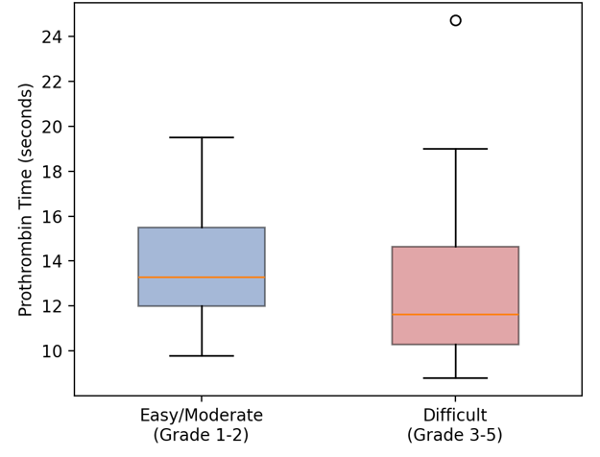
|
| Figure
2; Prothrombin time (seconds) by Parkland
difficulty category (Mann-Whitney
p=0.008). |
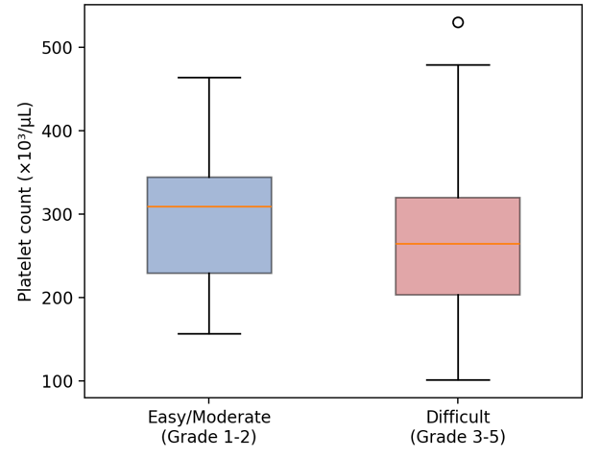
|
| Figure 3: Platelet count
(×10³/µL) by Parkland difficulty category
(Mann-Whitney p=0.037). |
Receiver
operating characteristic analysis
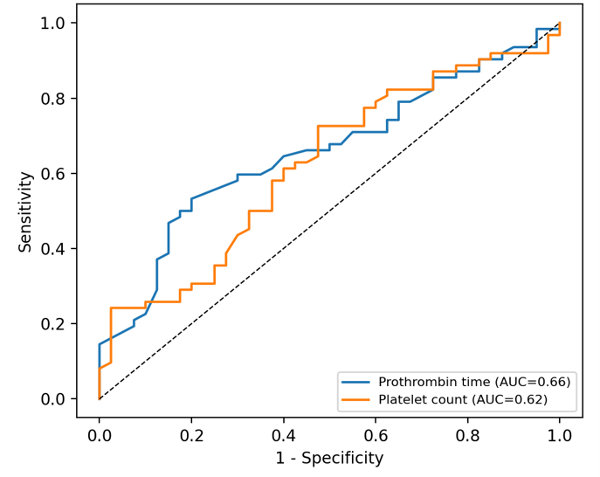
ROC curves were
constructed for the moderate-effect continuous
predictors identified on univariate and
multivariable analysis (Figure 4; Table 4); both
showed modest discriminative value, consistent
with the limited variance these variables
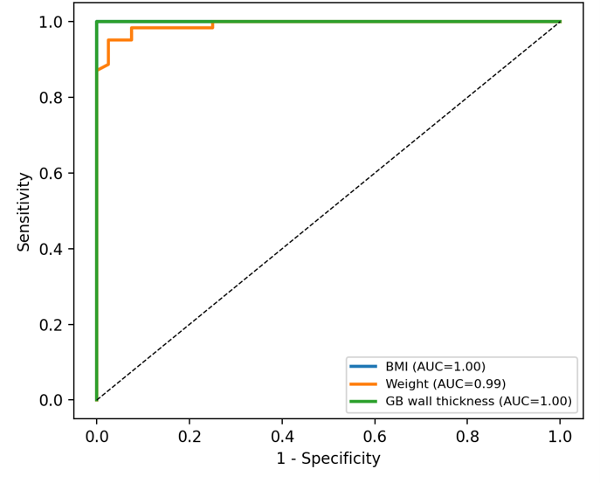
explained beyond the strong discriminators. BMI,
weight, and USG gallbladder wall thickness
achieved substantially higher AUCs (0.99-1.00) and
are presented separately in Table 5 and Figure 5,
above/below, as standalone cut-off-based
discriminators rather than alongside the
moderate-effect predictors in Table 4.
|
| Figure
4: ROC curves for prothrombin time and
platelet count as predictors of a
Difficult (grade 3-5) intraoperative
course. Diagonal reference line represents
no discrimination (AUC=0.5). |
|
Table 4: ROC/AUC summary for the
moderate-effect continuous predictors of
a Difficult intraoperative course (see
Table 5 for the strong discriminators
BMI, weight, and GB wall thickness).
|
|
Predictor
|
AUC
|
Optimal cut-off
|
Sensitivity (%)
|
Specificity (%)
|
|
Prothrombin time (seconds)
|
0.66
|
≤11.9
|
53.2
|
80.0
|
|
Platelet count (×10³/µL)
|
0.62
|
≤293
|
72.6
|
52.5
|
|
AUC, area under the receiver
operating characteristic curve; cut-offs
identified by the Youden index.
|
Strong
preoperative discriminators of operative
difficulty
BMI, weight, and USG
gallbladder wall thickness each discriminated
Easy/Moderate from Difficult cases with very high
accuracy (Table 5; Figure 5). A BMI cut-off of 25
kg/m² and a GB wall thickness cut-off of 4.3 mm
each achieved 100% sensitivity and 100%
specificity in this cohort (AUC 1.00 for both); a
weight cut-off of 68.8 kg achieved 95.2%
sensitivity and 97.5% specificity (AUC 0.99).
These cut-offs considerably exceed the
discrimination reported for the same markers in
previously published series (typical AUC
0.65-0.85) [6,7], and are presented as a notable
finding of this cohort rather than as an
already-validated clinical rule; external
validation in an independent cohort is recommended
before adoption into routine preoperative
counselling (see Discussion).
|
| Figure
5: ROC curves for BMI, weight, and USG
gallbladder wall thickness as preoperative
discriminators of a Difficult
intraoperative course. |
|
Table 5: Strong preoperative
discriminators of a Difficult (grade
3-5) intraoperative course, analysed as
standalone cut-offs (N=102).
|
|
Parameter
|
AUC
|
Cut-off
|
Sensitivity (%)
|
Specificity (%)
|
|
BMI (kg/m²)
|
1.00
|
≥25.0
|
100.0
|
100.0
|
|
USG gallbladder wall thickness
(mm)
|
1.00
|
≥4.3
|
100.0
|
100.0
|
|
Weight (kg)
|
0.99
|
≥68.8
|
95.2
|
97.5
|
|
Cut-offs identified by the Youden
index. AUC, area under the receiver
operating characteristic curve.
|
Discussion
In this prospective
cohort of 102 patients undergoing LC for
symptomatic cholelithiasis, 60.8% had a Difficult
(Parkland grade 3-5) intraoperative course. The
principal finding of this study is that three
simple, routinely available
preoperative/radiological measurements BMI,
weight, and USG gallbladder wall thickness
discriminated Easy/Moderate from Difficult cases
almost perfectly (AUC 0.99-1.00), each exceeding
the discrimination reported for the same markers
in the published literature (typical AUC
0.65-0.85) [6,7]. The present findings are
consistent with previous Indian studies that have
identified obesity and gallbladder wall thickening
as risk factors for difficult laparoscopic
cholecystectomy, although the magnitude of
discrimination observed in our cohort was
substantially greater than previously reported.
Operative time, an
intraoperative correlate rather than a
preoperative predictor, corroborated the same
separation, with every Easy/Moderate case
completed in a short theatre-time band and every
Difficult case in a longer one. Beyond these
strong discriminators, a smaller set of
moderate-effect variables comorbidity burden,
platelet count, and prothrombin time added
independent but modest information on
multivariable analysis (Nagelkerke R²≈0.11 for
this second model). We discuss the strong
discriminators first, then the moderate-effect
findings, before turning to strengths and
limitations.
BMI ≥25 kg/m² and
USG gallbladder wall thickness ≥4.3 mm each
achieved 100% sensitivity and 100% specificity for
a Difficult intraoperative course in this cohort,
and a weight cut-off of 68.8 kg achieved 95.2%
sensitivity and 97.5% specificity. These are
considerably higher levels of discrimination than
most published series report for the same markers
[6,7], where BMI and GB wall thickness are
consistently identified as predictors of a
difficult cholecystectomy but with substantial
overlap between easy and difficult groups (typical
AUC 0.65-0.85). We present this as a genuine and
clinically striking finding of the present cohort
rather than as an already-generalisable clinical
rule. Such unusually strong single-centre
discrimination can arise from several
non-mutually-exclusive sources: a case-mix or
population effect specific to this
tertiary-referral unit (for example, if the local
threshold for a difficult intraoperative grading
assessment is itself closely tied to visibly
higher BMI or a thicker, more oedematous
gallbladder wall on inspection); a genuinely
stronger biological relationship between body
habitus, wall thickening, and dissection
difficulty in this population than has been
captured elsewhere; or narrower-than-typical
variability in the measured range of BMI and wall
thickness within this particular sample (the
cohort spanned a comparatively narrow BMI range of
20-30 kg/m², which can inflate apparent
discrimination relative to cohorts with wider BMI
ranges). We are not in a position to adjudicate
between these explanations from a single-centre
dataset, and we recommend that these cut-offs be
treated as hypothesis-generating and tested for
reproducibility in an independent, ideally
multicentre, cohort before being adopted as a
preoperative counselling or triage rule. If
replicated, a BMI/GB-wall-thickness-based rule of
this kind would be an unusually simple and
low-cost addition to preoperative assessment,
requiring no additional investigations beyond a
weighing scale and the abdominal ultrasound
already performed as standard of care.
The association
between comorbidity burden (diabetes and/or
hypertension) and a difficult intraoperative
course is biologically plausible: chronic
hyperglycaemia and vascular disease are both
linked to impaired tissue healing, altered
inflammatory response, and higher rates of
gallbladder fibrosis, and diabetes in particular
is repeatedly identified as a risk factor for a
difficult or prolonged cholecystectomy in
preoperative scoring systems such as that of
Randhawa and Pujahari [5] and its subsequent
validations [6-8]. The independent association we
observed between a shorter prothrombin time and a
more difficult intraoperative course is less
readily explained by existing literature, which
more commonly discusses coagulopathy (prolonged
PT) as a marker of hepatic dysfunction or severe
sepsis rather than as a predictor in the opposite
direction; this counter-intuitive finding,
together with the platelet-count association,
should be treated as hypothesis-generating rather
than confirmatory, and, together with the modest
AUCs observed for both parameters (0.66 and 0.62
respectively), does not support their use as
stand-alone clinical predictors at this stage.
Given the modest AUC and the absence of a
well-established biological mechanism, the
association between shorter prothrombin time and
operative difficulty should be interpreted
cautiously and requires external validation.
Notably, CRP and
NLR, both widely reported as predictors of
complicated or difficult cholecystitis in
emergency and mixed elective-emergency cohorts
[9], were not significantly associated with
difficulty in our predominantly elective,
symptomatic (rather than acutely inflamed)
population. We attribute this discrepancy in part
to population selection (elective versus emergency
presentation) and in part to a probable floor
effect in CRP reporting: CRP values clustered
heavily at a single value (4.5 mg/L) in both
difficulty groups in this cohort, consistent with
a substantial proportion of results being reported
at or near the assay's lower limit of detection,
which would be expected to blunt CRP's
discriminative power in a predominantly
non-acutely-inflamed elective population
regardless of any true underlying biological
relationship.
Strengths and Limitations
The strengths of
this prospective study include the use of a
structured, pre-piloted data collection proforma
encompassing clinical, haematological,
biochemical, and radiological variables, and the
adoption of the validated Parkland Grading System
(PGS) as an objective intraoperative reference
standard. Additionally, the use of both cut-off
analysis for strong predictors and multivariable
modelling for moderate predictors enabled
interpretation of findings according to their
respective statistical characteristics.
This study has
several limitations. It was conducted at a single
tertiary-care centre and included a relatively
small sample size, limiting generalisability and
statistical power for infrequent outcomes. A
formal a priori sample-size calculation was not
performed. As an observational study, residual
confounding cannot be excluded. Furthermore,
Parkland Grade was prospectively documented in
only a minority of cases, with most grades
assigned retrospectively from operative records,
introducing potential classification bias. The
exceptionally high discriminatory performance
observed for BMI, weight, and gallbladder wall
thickness may partly reflect local case mix and
requires validation in larger multicentre
populations. Finally, no external validation
cohort was available, and the derived cut-offs
should therefore be regarded as
hypothesis-generating.
Conclusions
BMI, body weight,
and ultrasonographic gallbladder wall thickness
were the strongest preoperative predictors of a
difficult laparoscopic cholecystectomy as defined
by the Parkland Grading Scale. Comorbidity burden
and prothrombin time provided additional but
modest predictive information. Although these
findings support the potential role of simple
preoperative markers in operative risk
stratification, external multicentre validation is
required before routine clinical implementation of
the proposed cut-offs.
Patient's Informed Consent
Patient's informed and written consent taken.
Ethics Approval
Ethics approval was taken and approved by ethics
committee.
Funding
No fundings were done for this research.
Competing Interest
The authors declare that they have no known
competing financial interests or personal
relationships that could have appeared to
influence the work reported in this paper.
References
- Mohite SU, Panse N, Kannan R, Tapkire R,
Pradhan S, Gulia A, et al. Prevalence of
gallstone disease in India: insights from a
community-based cross-sectional study. BMJ
Public Health. 2026;4(1):e004015.
- Strasberg SM, Hertl M, Soper NJ. An analysis
of the problem of biliary injury during
laparoscopic cholecystectomy. J Am Coll
Surg. 1995;180(1):101-125.
- Madni TD, Leshikar DE, Minshall CT, Nakonezny
PA, Cornelius CC, Imran JB, et al. The Parkland
grading scale for cholecystitis. Am J Surg.
2018;215(4):625-630.
- Madni TD, Nakonezny PA, Barrios E, Imran JB,
Clark AT, Taveras L, et al. Prospective
validation of the Parkland Grading Scale for
Cholecystitis. Am J Surg. 2019;217(1):90-97.
- Randhawa JS, Pujahari AK. Preoperative
prediction of difficult lap chole: a scoring
method. Indian J Surg.
2009;71(4):198-201.
- Trehan M, Mangotra V, Singh J, Singla S,
Gautam SS, Garg R. Evaluation of preoperative
scoring system for predicting difficult
laparoscopic cholecystectomy. Int J Appl
Basic Med Res. 2023;13(1):10-15.
- Karim ST, Chakravarti S, Jain A, Patel G, Dey
S. Difficult laparoscopic cholecystectomy
predictors and its significance: our experience.
J West Afr Coll Surg. 2022;12(4):56-63.
- Kumar A, Chhabra MK, Chhibber P. Preoperative
prediction of difficult laparoscopic
cholecystectomy using a scoring system: a
prospective cohort study. Cureus.
2026;18(1):e102055.
- Mahmood F, Akingboye A, Malam Y, Thakkar M,
Jambulingam P. Complicated acute cholecystitis:
the role of C-reactive protein and
neutrophil-lymphocyte ratio as predictive
markers of severity. Cureus. 2021;13(2):e13527.
- von Elm E, Altman DG, Egger M, Pocock SJ,
Gøtzsche PC, Vandenbroucke JP; STROBE
Initiative. The Strengthening the Reporting of
Observational Studies in Epidemiology (STROBE)
statement: guidelines for reporting
observational studies. Lancet. 2007;370(9596):1453-1457.
- Albert A, Anderson JA. On the existence of
maximum likelihood estimates in logistic
regression models. Biometrika. 1984;71(1):1-10.
|


