|
Introduction
Maternal
healthcare referral systems are the cornerstone of
effective healthcare delivery, particularly in
resource-constrained settings serving vulnerable
populations [1–3]. Globally, effective and timely
referral mechanisms are essential components of
comprehensive emergency obstetric care (EmOC)
designed to ensure timely access to appropriate
levels of care for pregnant women experiencing
complications [4–6].
The three-tiered
public healthcare system in India, comprising
Primary Health Centres (PHCs), Community Health
Centres (CHCs), and District Headquarters
Hospitals (DHHs), forms the backbone of maternal
healthcare delivery in rural and tribal
regions[7,8]. This hierarchical system relies on
effective referral mechanisms to ensure that women
with obstetric complications identified at
peripheral facilities are stabilized and promptly
referred to higher-level centres, such as CHCs or
DHHs, which are designated as First Referral Units
(FRUs) capable of providing EmOC [9,10].
Tribal populations
in India face unique and compounded challenges in
accessing maternal healthcare services. These
communities often experience geographical
isolation, socio-cultural beliefs that may
discourage institutional care, transportation
difficulties, and economic constraints that
complicate healthcare-seeking behaviours[10–13].
The "three delays" framework, which identifies
delays in deciding to seek care, reaching
appropriate facilities, and receiving adequate and
appropriate quality care upon arrival, provides a
useful lens for understanding maternal mortality
patterns in these settings[2,14].
Odisha, with a
22.85% tribal population, is home to 13 of India’s
75 Particularly Vulnerable Tribal Groups
(PVTGs)[15]. These communities represent some of
the most marginalized populations in the country,
facing significant healthcare disparities,
including significantly poorer maternal health
indicators than mainstream populations[16,17].
Despite government initiatives, such as the Janani
Shishu Suraksha Karyakram (JSSK), to improve
maternal health outcomes, tribal communities
continue to experience challenges in accessing and
utilizing quality maternal healthcare
services[18–20].
Recent studies have
highlighted that while some PVTG populations in
Odisha have achieved utilization rates comparable
to the national averages for certain maternal
health indicators, significant gaps remain in
institutional delivery rates and quality of care.
The persistence of these disparities indicates
that tailored approaches are required to
effectively address maternal health challenges in
tribal communities[19,21].
Understanding
referral patterns and their temporal variations is
crucial for optimizing maternal healthcare
delivery systems[22]. However, limited research
has examined the specific dynamics of obstetric
referrals in tribal districts, particularly
regarding day-night variations in referral
patterns and the quality of pre-referral
stabilization and management provided at
lower-level facilities before transfer[23–25].
This study addresses
critical knowledge gaps by examining maternal
referral patterns in the Gajapati district of
Odisha, a predominantly tribal district with a
significant PVTG population. The specific
objectives were to (1) analyse temporal patterns
of obstetric referrals, including day-night
variations; (2) assess correlations between
delivery volumes and referral dynamics; (3)
evaluate the quality of pre-referral management
for common obstetric complications; and (4)
identify system-level factors influencing referral
effectiveness in tribal healthcare contexts.
Materials and Methods
Study Design
and Setting
This prospective
observational study was conducted at the Maternal
and Child Health (MCH) unit of the District
Headquarters Hospital (DHH), Paralakhemundi,
Gajapati District, Odisha, India. The study period
extended from July 2024 to August 2025,
encompassing 14 months of continuous data
collection.
DHH Paralakhemundi
serves as the sole First Referral Unit (FRU) for
this tribal-dominated district, functioning as a
161-bedded facility within the apex tier of the
district's healthcare network. The Gajapati
district comprises 30 government healthcare
facilities, including one DHH, eight CHCs, and 21
PHCs, serving a population with significant
representation of PVTGs [26].
Study
Population
The study population
included all pregnant women who delivered at the
Maternal Child Health (MCH) unit during the study
period, as well as those referred to or from the
facility for obstetric care. During the 14-month
observation period, 2,759 deliveries were
conducted at the facility, with 909 cases referred
from lower-level facilities and 451 cases referred
to higher-level tertiary care centres
(referrals-out).
Data
Collection
Data were collected
prospectively using a structured checklist
designed specifically for this study to
systematically document referral parameters. The
checklist captured: demographic information of
referred patients; temporal data (date and time of
referral, categorised as day [08:00–20:00] or
night [20:00–08:00]); source facility for
referrals-in and destination facility for
referrals-out; primary reason for referral;
clinical status at referral; pre-referral
management provided at the referring facility;
mode of transport; transfer time; and maternal and
foetal outcomes.
Variables
and Measurements
The primary
variables were: total
monthly deliveries at the MCH unit; referral-in
count (cases referred to the DHH from lower-level
facilities); referral-out count (cases referred
from the DHH to higher-level centres); and the
day-night distribution of referrals.
The
pre-referral management was assessed
against the minimum essential intervention
expected before referral for each complication,
namely: antibiotics for premature rupture of
membranes (PROM); partograph use for monitoring
labour; antenatal corticosteroids for preterm
labour; magnesium sulphate for
eclampsia/pre-eclampsia; initial management of
obstetric haemorrhage; neonatal resuscitation for
birth asphyxia; initiation of treatment for
maternal and neonatal sepsis; and preliminary
management of severe anaemia. For each
complication, a pre-referral management score was
derived as the mean monthly number of referred
cases in which the corresponding minimum essential
intervention was documented as having been
provided, with the standard deviation summarising
month-to-month variability.
Data
Analysis
Data analysis was
performed using the Statistical Package for Social
Sciences (SPSS) version 26.0[27]. Descriptive
statistics (frequencies, percentages, means,
standard deviations) characterised monthly
delivery volumes and referral patterns. Pearson’s
correlation coefficients examined relationships
between total deliveries and total referrals (in
and out), between daytime and nighttime referral
patterns, and between referral-in and referral-out
volumes; Spearman’s rank coefficients were
computed in parallel to assess monotonic
associations robust to non-normality. Asymptotic
standard errors and approximate T-values are
reported. A trend analysis was conducted to
describe monthly delivery and referral dynamics
over the 14-month period, with model fit
summarised by stationary R-squared, RMSE, MAPE,
MaxAPE, MAE, MaxAE, and Normalised BIC.
Statistical significance was set at p<0.05.
Given the modest number of monthly observations
(n=14) and the multiple correlations tested,
associations are interpreted as exploratory.
Ethical
Considerations
The study was
conducted according to the Declaration of Helsinki
and approved by the Institutional Ethics Committee
of Medipulse Hospital, Jodhpur (approval no.
MH/IEC/2024/BHR/0007, September 11, 2024).
Permission was obtained from the Chief District
Medical and Public Health Officer (CDM andPHO) of
the Gajapati district. All data were anonymized to
protect the patients’ confidentiality. As this was
an observational study of routine clinical data,
the requirement for individual informed consent
was waived by the ethics committee.
Results
Overview of Deliveries and Referrals
During the 14-month
study period, 2,759 deliveries were conducted at
the MCH unit of the District Headquarters
Hospital. The monthly delivery count ranged from
88 to 230, with a mean of 197.07 (SD=33.269).
Throughout this period, the facility received 909
referrals (referred in) and transferred 451
patients to higher-level facilities (referred
out). The referral-in and referral-out rates were
32.9% and 16.3% of total deliveries, respectively.
|
Table 1: Monthly Delivery and
Referral Data (July 2024 - August 2025)
|
|
Month
|
Total Deliveries
|
Total Referred In
|
Total Referred Out
|
|
July-24
|
88
|
66
|
37
|
|
Aug-24
|
215
|
57
|
37
|
|
Sep-24
|
195
|
44
|
31
|
|
Oct-24
|
218
|
65
|
34
|
|
Nov-24
|
199
|
72
|
44
|
|
Dec-24
|
200
|
72
|
43
|
|
Jan-25
|
206
|
76
|
44
|
|
Feb-25
|
230
|
58
|
25
|
|
Mar-25
|
209
|
58
|
27
|
|
Apr-25
|
215
|
52
|
30
|
|
May-25
|
201
|
74
|
30
|
|
June-25
|
195
|
74
|
30
|
|
July-25
|
189
|
67
|
25
|
|
Aug-25
|
199
|
74
|
14
|
|
Total
|
2,759
|
909
|
451
|
Temporal
Analysis of Referral Patterns
Analysis of
day-night referral patterns revealed significant
temporal variations in the referral dynamics
(Tables 2-5; Figure 1).
|
Table 2: Correlation Analysis -
Daytime Referrals-in and Total
Referrals-in
|
|
Correlation Type
|
Value
|
Asymptotic Standard Error
|
Approximate T
|
Significance
|
|
Pearson's R
|
0.862
|
0.053
|
5.891
|
<0.001
|
|
Spearman Correlation
|
0.855
|
0.099
|
5.713
|
<0.001
|
Daytime referrals-in
(08:00 to 20:00) showed a strong positive
correlation with total referrals-in (Pearson's
R=0.862, p<0.001). The Spearman correlation
coefficient (0.855, p<0.001) further confirmed
this strong relationship, indicating that
variations in daytime referrals strongly predicted
the overall referral-in pattern at the facility.
|
Table 3: Correlation Analysis -
Nighttime Referrals In and Total
Referrals In
|
|
Correlation Type
|
Value
|
Asymptotic Standard Error
|
Approximate T
|
Significance
|
|
Pearson's R
|
0.466
|
0.225
|
1.824
|
0.093
|
|
Spearman Correlation
|
0.310
|
0.335
|
1.128
|
0.281
|
Nighttime
referrals-in (20:00 to 08:00 ) demonstrated a
moderate positive correlation with total
referrals-in (Pearson's R=0.466), although this
relationship was not statistically significant
(p=0.093). The Spearman correlation coefficient
(0.310, p=0.281) also showed a weak positive
relationship, suggesting that nighttime referrals
contribute less consistently to the overall
referral-in pattern than daytime referrals.
|
Table 4: Correlation Analysis -
Nighttime Referrals In and Nighttime
Referrals Out
|
|
Correlation Type
|
Value
|
Asymptotic Standard Error
|
Approximate T
|
Significance
|
|
Pearson's R
|
0.571
|
0.155
|
2.060
|
0.033
|
|
Spearman Correlation
|
0.507
|
0.202
|
2.039
|
0.064
|
A significant
positive correlation was observed between
nighttime referrals-in and nighttime referrals-out
(Pearson's R=0.571, p=0.033), indicating that
increases in nighttime referrals-in are associated
with increases in nighttime referrals-out,
suggesting a potential "pass-through" phenomenon
during the night hours.
|
Table 5: Day-Night Referral
Distribution
|
|
Referral Type
|
Mean
|
Standard Deviation
|
|
Day Referrals-In (08:00 to 20:00)
|
41.07
|
9.352
|
|
Night Referrals-In (20:00 to 8:00)
|
24.57
|
4.847
|
|
Day Referrals-Out (08:00 to 20:00)
|
16.29
|
4.159
|
|
Night Referrals-Out (20:00 to 8:00)
|
15.93
|
6.545
|
The facility
received more referrals during the daytime
(M=41.07, SD=9.352) than during the nighttime
(M=24.57, SD=4.847). Similarly, more patients were
referred during the daytime (M=16.29, SD=4.159)
than during the nighttime (M=15.93, SD=6.545),
although this difference was smaller (Figure 1).
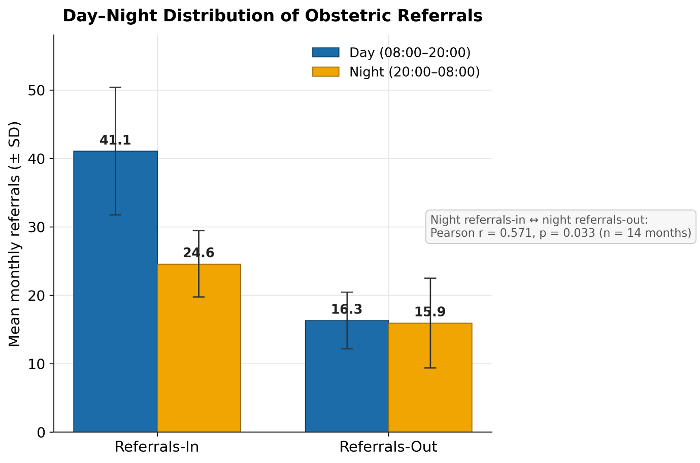
|
| Figure
1: Day–night distribution of obstetric
referrals (referrals-in and
referrals-out), District Headquarters
Hospital, Gajapati District, Odisha (July
2024 – August 2025). Bars show mean
monthly referrals; whiskers denote ±1 SD.
|
Correlation
Between Deliveries and Referrals
Total deliveries
showed weak, non-significant correlations with
total referrals-in (r=−0.144, p=0.625) and total
referrals-out (r=−0.153, p=0.602). Referrals-in
and referrals-out were weakly and
non-significantly correlated (r=0.166, p=0.571).
Delivery volume was therefore not strongly related
to referral activity.
Time Series
Analysis Results
The trend model of
monthly deliveries and referrals showed a
stationary R-squared of 0.725, explaining 72.5% of
the variance, with RMSE=18.973, MAPE=6.311,
MaxAPE=26.909, MAE=10.570, MaxAE=37.506, and
Normalised BIC=6.452. Given the short series (14
monthly points), these estimates are descriptive
rather than predictive.
Pre-referral
Management Quality
Pre-referral
management varied considerably across
complications (Figure 2). It was highest for birth
asphyxia (mean=8.0, SD=5.0), followed by PROM
(mean=4.0, SD=2.0) and eclampsia (mean=4.0,
SD=3.0). Severe pre-eclampsia also received
substantial management (mean=3.4, SD=3.0).
Moderate management was seen for obstructed labour
(mean=2.0, SD=3.0) and preterm labour (mean=2.0,
SD=2.0); lower levels for foetal distress,
neonatal sepsis, and severe anaemia (each
mean=1.0). No pre-referral management was recorded
for delayed labour progress or postpartum
haemorrhage (both mean=0.0, SD=0.0), and maternal
sepsis received minimal management (mean=0.0,
SD=1.0). The wide standard deviations indicate
inconsistent application of pre-referral protocols
across months.
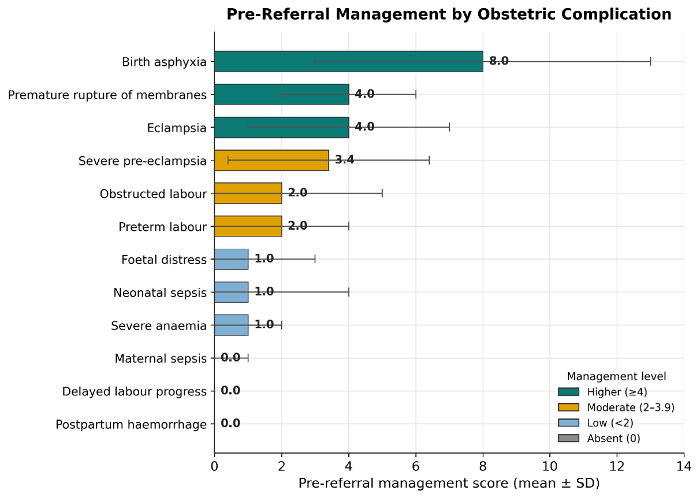
|
| Figure
2: Pre-referral management by obstetric
complication, District Headquarters
Hospital, Gajapati District, Odisha (July
2024 – August 2025). Bars show the mean
monthly pre-referral management score (±1
SD); lower whiskers are truncated at zero
because scores cannot be negative.
|
Discussion
This prospective
analysis of obstetric referral patterns in a
tribal district of Odisha provides important
insights into the functioning of maternal
healthcare delivery systems that serve vulnerable
populations. The findings revealed significant
temporal disparities, quality gaps in pre-referral
management, and concerning patterns that suggest
inadequate emergency obstetric care capacity
during critical periods[28,29].
Temporal
Disparities in Referral Patterns
The strong
correlation between daytime referrals-in and total
referrals-in (r=0.862, p<0.001) contrasted
markedly with the weaker correlation observed
during nighttime hours (r=0.466, p=0.093). These
findings highlight pronounced diurnal variations
in healthcare-seeking behavior and referral
decision-making processes. Such temporal
disparities likely reflect multiple factors,
including transportation availability, family
decision-making patterns, and provider readiness
at referring facilities during different
periods[30].
The significant
correlation between nighttime referrals-in and
nighttime referrals-out (r=0.571, p=0.033)
suggests a concerning "pass-through" phenomenon,
in which patients referred during night hours are
subsequently transferred to higher facilities
without substantial intervention at the district
hospital level. This pattern indicates potential
limitations in the facility's capacity to manage
complex obstetric emergencies during nighttime
hours, raising important questions about staffing
patterns, resource availability, and provider
confidence in managing critical cases during night
shifts[31].
Quality Gaps
in Pre-referral Management
Substantial
variations in the quality of pre-referral
management represent a critical finding with
immediate clinical implications. Birth asphyxia
received the highest management scores (mean=8.0,
SD=5.0), likely reflecting the widespread
recognition of neonatal resuscitation as an
essential clinical skill. However, the high
standard deviation indicates inconsistent
application, even for this well-recognized
emergency condition.
Figure 2 starkly
visualizes the quality disparities in pre-referral
management. The complete absence of pre-referral
management for postpartum haemorrhage and delayed
labour progress (both mean=0.0, SD=0.0) is
particularly concerning, given that these
conditions are among the leading direct causes of
maternal mortality globally[32]. The inability to
provide initial stabilization measures before
referral significantly compromises patient
outcomes and suggests fundamental gaps in the
emergency obstetric care capacity at peripheral
facilities.
The color-coded
representation in Figure 2 immediately highlights
the critical quality gaps: while birth asphyxia,
PROM, and eclampsia receive relatively good
management (green bars), conditions such as
postpartum haemorrhage show virtually no
pre-referral intervention (dark red minimal bars).
This visualization powerfully demonstrates the
need for urgent interventions in the referral
system.
Independence
of Referral Patterns from Delivery Volumes
The absence of
significant correlations between total deliveries
and referral patterns challenges the conventional
assumptions regarding healthcare utilization
dynamics. This finding suggests that referral
decisions are influenced more by case complexity,
provider capacity, and institutional factors than
by patient volumes. Such independence indicates
that the effectiveness of the referral system
depends on qualitative factors, including provider
competency, facility readiness, and case-specific
clinical decision-making, rather than simple
patient load considerations[21,33].
Implications
for Health System Strengthening
The temporal
disparities identified highlight the urgent need
for enhanced night-shift capabilities, including
improved staffing patterns, targeted training
initiatives, and resource allocation, to ensure
24-hour readiness for complex obstetric cases[1].
The variability in pre-referral management
suggests that standardization of protocols,
coupled with regular training and supportive
supervision, could significantly improve the
quality of initial care before referral[34].
Enhanced
communication systems between referring and
receiving facilities could improve coordination
and ensure appropriate preparation for incoming
referrals[23]. The significant correlation between
nighttime referrals-in and referrals-out suggests
that improved night-shift capacity at the district
level could reduce unnecessary onward referrals
and improve overall system efficiency[33].
Context-Specific
Considerations for Tribal Healthcare
These findings must
be interpreted within the specific context of
tribal healthcare delivery, where communities face
multiple intersecting barriers, including
geographical isolation, cultural preferences,
economic constraints, and historical
marginalization from mainstream healthcare
services[35,36]. The achievement of relatively
high referral utilization rates suggests that
institutional barriers may be more amenable to
intervention than previously assumed, provided
that appropriate strategies are implemented[37].
Limitations
As a single-center
study, its generalizability to other tribal
districts or healthcare settings may be limited.
The observational nature of the study precludes
definitive causal inferences regarding the
observed associations. The 14-month observation
period, although substantial, may not capture
longer-term trends or seasonal variations.
Additionally, the study documents referral
patterns and quality gaps but does not provide
direct insights into healthcare provider
decision-making processes or patient experiences
in the referral system.
Future
Research
Future work should
examine provider decision-making across shifts,
patient-centred experiences of referral, and
intervention studies testing standardised
pre-referral protocols and enhanced communication
systems. Comparative studies across tribal
districts could identify transferable best
practices for referral-system strengthening.
Conclusions
This analysis
reveals temporal disparities in the obstetric
referral system serving a tribal population in
Eastern India. The strong daytime but weaker
nighttime referral correlations indicate a need
for enhanced night-shift capability, and the
association between nighttime referrals-in and
referrals-out is consistent with a possible
pass-through of cases during critical hours. The
wide variation in pre-referral management from
comprehensive care for birth asphyxia to no
recorded intervention for postpartum haemorrhage
underscores the need for standardised protocols,
while the independence of referral patterns from
delivery volume indicates that factors beyond
caseload drive referrals. For tribal populations,
strengthening maternal referral systems will
require attention to both supply-side factors
(provider capacity, facility readiness) and
demand-side considerations (cultural
appropriateness, geographical access). These
findings offer concrete targets addressing the
nighttime pass-through through enhanced
district-level EmOC and implementing pre-referral
protocols for life-threatening conditions relevant
to maternal-health programmes in tribal regions.
Conflict of Interest:
The authors declare no conflict of interest.
Funding:
This research received no specific grant from any
funding agency.
References
- Kruk ME, Gage AD,
Arsenault C et al. High-quality health systems
in the Sustainable Development Goals era: time
for a revolution. The Lancet Global Health
2018;6:e1196–252.
- Thaddeus S, Maine D. Too far to walk: Maternal
mortality in context. Social Science and
Medicine 1994;38:1091–110.
https://doi.org/10.1016/0277-9536(94)90226-7.
- Goodman DM, Srofenyoh EK, Olufolabi AJ, Kim
SM, Owen MD. The third delay: understanding
waiting time for obstetric referrals at a large
regional hospital in Ghana. BMC Pregnancy
Childbirth 2017;17:216.
https://doi.org/10.1186/s12884-017-1407-4.
- WHO. Standards for improving quality of
maternal and newborn care in health facilities.
[Internet]. World Health Organization. Geneva,
2016 [cited 2026 June 18]. Available from: https://www.who.int/publications/i/item/9789241511216
- Paxton A, Maine D, Freedman L, Fry D, Lobis S.
The evidence for emergency obstetric care. Intl
J Gynecology and Obste 2005;88:181–93.
https://doi.org/10.1016/j.ijgo.2004.11.026.
- World Health Organization, United Nations
Population Fund, United Nations Children’s Fund,
Columbia University, Mailman School of Public
Health, Averting Maternal Death and Disability.
Monitoring emergency obstetric care: a handbook
[Internet]. Geneva: World Health Organization;
2009 [cited 2026 June 18]. Available from: https://www.who.int/publications/i/item/9789241547734
- Ministry of Health and Family Welfare,
Government of India. Indian public health
standards. Vol. III, Health and wellness
centre–primary health centre [Internet]. New
Delhi: Ministry of Health and Family Welfare;
2022 [cited 2026 June 18]. Available from: https://nhm.gov.in/images/pdf/guidelines/iphs/iphs-revised-guidlines-
2022/03_PHC_IPHS_Guidelines-2022.pdf
- Ministry of Health and Family Welfare,
Government of India. Update on health systems in
rural and tribal areas [Internet]. New Delhi:
Press Information Bureau; 2023 Feb 7 [cited 2026
June 18]. Available from: https://www.pib.gov.in/Pressreleaseshare.aspx?PRID=1896950
- Singh S, Doyle P, Campbell OMR, Rao GVR,
Murthy GVS. Transport of pregnant women and
obstetric emergencies in India: an analysis of
the ‘108’ ambulance service system data. BMC
Pregnancy Childbirth 2016;16:318.
https://doi.org/10.1186/s12884-016-1113-7.
- Mavalankar D, Singh A, Patel SR, Desai A,
Singh PV. Saving mothers and newborns through an
innovative partnership with private sector
obstetricians: Chiranjeevi scheme of Gujarat,
India. International Journal of Gynecology
and Obstetrics 2009;107:271–6.
https://doi.org/10.1016/j.ijgo.2009.09.008.
- Mudi PK, Pradhan MR. Utilization of maternal
healthcare services and its determinants among a
particularly vulnerable tribal group (PVTG) in
Odisha, India. IER Journal of Health and
Demography. 2023;9(1):18-36.
- Sengupta A, Sahoo M, Khan A, Shaikh R, Khan R.
Maternal health status in tribal India: A 5-year
intervention program and its outcome. Indian
Journal of Community Medicine 2020;45:189–93.
- Madankar M, Kakade N, Basa L, Sabri B.
Exploring maternal and child health among tribal
communities in India: A life course perspective.
Global Journal of Health Science
2024;16:31.
- Sahoo M, Pradhan J. Using Three Delay Model to
Understand the Social Factors Responsible for
Neonatal Deaths Among Displaced Tribal
Communities in India. J Immigrant Minority
Health 2021;23:265–77.
https://doi.org/10.1007/s10903-020-00990-y.
- Scheduled Castes and Scheduled Tribes Research
and Training Institute. The tribes of Odisha
[Internet]. Bhubaneswar: Scheduled Castes and
Scheduled Tribes Research and Training
Institute. [cited 2026 June 18]. Available from:
https://www.scstrti.in/index.php/communities/tribes
- Sharma Y, Sridevi P, Bhat D, Surti SB, Sarmah
J, Sudhakar G, et al. Access to Healthcare Among
Tribal Population in India: A Cross‐Sectional
Household Survey. Health Planning and Management
2025:hpm.3924. https://doi.org/10.1002/hpm.3924.
- Ghosal J, Bal M, Das A et al. To leave no one
behind: Assessing utilization of maternal
newborn and child health services by all the 13
particularly vulnerable tribal groups (PVTGs) of
Odisha, India. Health Res Policy Sys
2024;22:12.
https://doi.org/10.1186/s12961-023-01101-7.
- Ministry of Health and Family Welfare,
Government of India, Maternal Health Division.
Guidelines for Janani-Shishu Suraksha Karyakram
(JSSK) [Internet]. New Delhi: Ministry of Health
and Family Welfare; 2011 [cited 2026 June 18].
Available from: https://nhm.gov.in/images/pdf/programmes/maternal-
health/guidelines/guidelines_for_jssk.pdf
- Rekha S, Mohan NV, Vaidyanathan G, Dash U,
Muraleedharan VR. Wealth and education-related
inequalities in the utilisation of reproductive,
maternal, newborn, and child health
interventions within scheduled tribes in India:
an analysis of Odisha and Jharkhand. BMC
Public Health. 2024;24(1):1605.
doi:10.1186/s12889-024-18857-4.
- Kshatri JS, Ak K, Rehman T et al. A
comprehensive assessment of health indicators
among tribal populations in Odisha, India
(Odisha Tribal Family Health Survey): a
community-based, cross-sectional study. Lancet
Reg
Health Southeast Asia. 2025;38:100611.
doi:10.1016/j.lansea.2025.100611.
- Singh S, Doyle P, Campbell OM, Mathew M,
Murthy GVS. Referrals between Public Sector
Health Institutions for Women with Obstetric
High Risk, Complications, or Emergencies in
India – A Systematic Review. PLoS ONE 2016;11:e0159793.
https://doi.org/10.1371/journal.pone.0159793.
- Hofmeyr GJ, Haws RA, Bergström S et al.
Obstetric care in low-resource settings: what,
who, and how to overcome challenges to scale up?
International Journal of Gynecology and
Obstetrics 2009;107:S21–45.
- Daniels AA, Abuosi A. Improving emergency
obstetric referral systems in low and middle
income countries: a qualitative study in a
tertiary health facility in Ghana. BMC Health
Serv Res 2020;20:32.
https://doi.org/10.1186/s12913-020-4886-3.
- Afari H, Hirschhorn LR, Michaelis A, Barker P,
Sodzi-Tettey S. Quality improvement in emergency
obstetric referrals: qualitative study of
provider perspectives in Assin North district,
Ghana. BMJ Open 2014;4:e005052.
https://doi.org/10.1136/bmjopen-2014-005052.
- Bhoi N, Acharya SK. Health status of
particularly vulnerable tribal groups (PVTGs) of
Odisha: a narrative review. J Health Popul
Nutr 2024;43:176.
https://doi.org/10.1186/s41043-024-00671-8.
- Panda PK, Sharma R. Caesarean section patterns
among PVTGs: a comparative analysis in Eastern
India. Online J Health Allied Scs [Internet].
2024 [cited 2026 June 18];23(4):1. Available
from: https://www.ojhas.org/issue92/2024-4-1.html
- Field A. Discovering statistics using IBM SPSS
statistics. 6th ed. London: SAGE Publications
Ltd; 2024.
- Panda PK, Subudhi C. Pattern and Determinants
of Maternal and Child Healthcare Services Among
Tribals: With a Special Reference to Tribal
Regions of Odisha. Journal of Development
Policy and Practice 2020;5:167–83.
https://doi.org/10.1177/2455133320935536.
- Patras K, Khanna A. Study to explore referral
mechanism of pregnant women in Kandhamal
district, Odisha. In: Emerging trends in
healthcare management [Internet]. [place
unknown]: Noble Science Press; 2023 [cited 2026
June 18]. p. 61-4. Available from: https://noblesciencepress.org/chapters_pdf/Book_15.pdf
doi:10.52458/9788196830076.2023.eb.ch-15.
- Cáceres ÁL, Ramesh RM, Newmai P, Kikon R,
Deckert A. Perceptions, health seeking behavior
and utilization of maternal and newborn health
services among an indigenous tribal community in
Northeast India—a community-based mixed methods
study. Frontiers in Public Health 2023;11:1139334.
- McGurgan P. Hiding in plain sight:
Inconvenient facts for patient safety in
non‐24/7 theatre on‐site staffed obstetric
units. Aust NZ J Obst Gynaeco 2023;63:606–11.
https://doi.org/10.1111/ajo.13701.
- Siswosudarmo R. Effect of Delay in Postpartum
Hemorrhage Management on the Rate of Near-Miss
and Maternal Death Cases. Indonesian Journal
of Obstetrics and Gynecology 2014:177–81.
- Mgawadere F, Unkels R, Kazembe A, Van Den
Broek N. Factors associated with maternal
mortality in Malawi: application of the three
delays model. BMC Pregnancy Childbirth
2017;17:219.
https://doi.org/10.1186/s12884-017-1406-5.
- Bailey PE, Andualem W, Brun M et al.
Institutional maternal and perinatal deaths: a
review of 40 low and middle income countries. BMC
Pregnancy Childbirth 2017;17:295.
https://doi.org/10.1186/s12884-017-1479-1.
- Soman B, Lathika AR, Unnikrishnan B, Shetty
RS. Tracing the Disparity Between Healthcare
Policy–Based Infrastructure and Health
Belief–Lead Practices: a Narrative Review on
Indigenous Populations of India. J Racial and
Ethnic Health Disparities 2024;11:3572–83.
https://doi.org/10.1007/s40615-023-01810-3.
- Kumar MM, Pathak V, Ruikar M. Tribal
population in India: A public health challenge
and road to future. J Family Med Prim Care
2020;9:508.
https://doi.org/10.4103/jfmpc.jfmpc_992_19.
- Kanrar P, Goswami M, Roy S. Health issues of
the indigenous communities with special
reference to the Particularly Vulnerable Tribal
Groups (PVTGs) of Odisha: a review.
Papers on Anthropology. 2023;32(1):45-80.
doi:10.12697/poa.2023.32.1.05.
|


