|
Introduction
The
right to affordable quality healthcare is a basic
right that every person should have and it is one
of the objectives of healthcare systems globally.
In India many people live in households that are
very poor and subject to healthcare induced out of
pocket expenses causing further impoverishment. As
per the World Bank[1], OOP expenditure on health
is 39.4%. and contributes to medical
impoverishment. Hence, financial risk protection
during ill health is an important goal in India’s
journey towards Universal Health Coverage (UHC)
and thus to address this issue, the Ayushman
Bharat-Pradhan Mantri Jan Arogya Yogna (AB-PMJAY)
scheme was launched on 23 September 2018. AB-PMJAY
is a health assurance programme funded by the
government to provide cashless and paperless
hospital care for beneficiaries (with annual
family income below INR 5 lakh (approximately USD
5000), informal workers and citizens above 70
years). Currently, as per these criteria there are
around 120 million families (roughly 550 million
individuals) eligible for this scheme. The scheme
covers all direct expenses during hospitalisation
(including preexisting diseases), day care
procedures, pre-hospitalisation (3 days) and post
hospitalisation (15 days) expenses (diagnostics
and medicines)[2]. However, it excludes outpatient
consultation expenses and medicine expenses not
associated with hospitalisation. As on early 2026,
the scheme has empaneled 37,385 hospitals
nationally and distributed 435.2 million
individual cards of which 41 million were
distributed in the state of Bihar (which has 1188
empaneled hospitals).
Despite macro-level
achievements, empirical data consistently indicate
a substantial divergence between design intent and
implementation outcomes, particularly evident
within low-income states in India such as Bihar.
Despite including over 10 million families
eligible for the scheme, Bihar consistently
demonstrates some of the lowest performance
metrics regarding enrolment, utilisation, and
financial protection[3]. Specifically, Bihar's
card-to-hospitalisation ratio[4] is approximately
2.2%, a figure markedly lower than those observed
in states such as Tamil Nadu (with 9.05 million
admissions) and Karnataka (with 6.60 million
admissions). Furthermore, Bihar accounts for 16%
of all inter-state AB-PMJAY hospitalisations,
which suggests a potential inadequacy in local
healthcare facility[5]. Given the above context,
this study aims at understanding the
implementation of the AB-PMJAY scheme in Nawada
district of Bihar.
Study objectives:
1. To assess the level of awareness of AB-PMJAY
and its various features among eligible
beneficiaries in Nawada district, Bihar.
2. To study the utilisation pattern of the
AB-PMJAY scheme among eligible beneficiaries and
understand the barriers to utilisation.
3. To measure the extent of financial risk
protection for healthcare costs among the study
population.
Methods
The study used a
mixed-methods cross sectional design with data
collected during May- July 2025. The quantitative
component used a structured interview schedule
(n=130) to capture data on awareness, utilisation,
and financial risk protection from eligible
households. The qualitative component comprised 20
in-depth interviews (IDIs) with eligible
beneficiaries to contextualise, deepen, and
interpret the quantitative findings. Healthcare
provision within Nawada district is underpinned by
a hierarchical network of governmental facilities,
including the District Hospital, Sub-district
Hospitals, Community Health Centres (CHCs), and
Primary Health Centres (PHCs). This is
complemented by a limited presence of private
nursing homes and clinics, primarily situated in
Nawada town. A substantial portion of secondary
and tertiary care services is accessed either at
the District Hospital or via referrals to larger
urban centers such as Gaya and Patna.
Inclusion and
exclusion criteria
For inclusion in the
study, households had to satisfy several
conditions: Firstly, they were required to be
officially registered as AB-PMJAY-eligible based
on the Socio-Economic Caste Census (SECC) data or
possess valid AB-PMJAY cards. Secondly, at least
one household member had to experience an
inpatient hospital admission lasting a minimum of
one night, within the 12 months preceding the data
collection phase. Thirdly, an adult respondent
from the household needed to provide written
informed consent to participate. Accordingly,
households were excluded if their reported
hospitalisation fell outside this 12-month recall
window, if they were unable to provide adequate
confirmation of AB-PMJAY eligibility, or if they
declined to participate in the study.
Data collection
instruments
The research
employed two distinct instruments for data
collection. These included: (i) a pre-tested
structured interview schedule, designed to gather
information on household profiles, AB-PMJAY
awareness, scheme utilisation patterns, and
financial risk protection; and (ii) a
semi-structured IDI guide, which facilitated
exploration of scheme experiences, hospital
encounters, financial impact, and suggestions from
beneficiaries. The interview schedule underwent
pilot testing with 10 households in a village not
included in the main study. During this phase,
ambiguities noted within the financial risk
protection section and caste coding protocols were
clarified. Structured interviews typically spanned
20–25 minutes, while IDIs extended to 40–60
minutes. All interviews were conducted in Hindi,
audio-recorded with participant consent,
subsequently transcribed, and then translated into
English.
Measurement of
catastrophic health expenditure
Out-of-pocket
expenditure (OOPE) per hospitalisation episode was
calculated by integrating all direct financial
expenses specifically consultation fees, surgical
procedures, prescribed medications, and diagnostic
services, while indirect expenditures included
transportation, food, and accommodation for both
the patient and any accompanying caregivers.
Subsequent to this aggregation, any monetary
reimbursements received were subtracted from the
total. Consistent with the methodological
framework articulated by Wagstaff and van
Doorslaer[6], households were deemed to experience
catastrophic health expenditure (CHE) if their
computed OOPE surpassed 10% of their total monthly
consumption expenditure. This evaluation of CHE
was performed twice, first considering only direct
costs, and then incorporating the combined sum of
both direct and indirect costs.
Quantitative
analysis
Initially,
quantitative data underwent double-entry
validation to ensure accuracy. Subsequent analysis
involved descriptive statistics, specifically
frequencies, percentages, means, and standard
deviations. To ascertain the independent
predictors of scheme awareness, utilisation, and
the incidence of catastrophic health expenditure
(CHE), binary logistic regression was performed.
This model adjusted for several covariates,
including education level, caste, gender, housing
type, and possession of the AB-PMJAY card. The
findings are presented as adjusted odds ratios
(AOR) with corresponding 95% confidence intervals.
Qualitative
analysis
The IDI transcripts
were analysed using thematic analysis as described
by Braun and Clarke[7]. First a list of themes was
made based on the three goals of the study.
Additional themes emerging while analysing the IDI
transcripts were also included in the analysis. A
narrative synthesis of the qualitative findings
was conducted and interpreted.
Ethical
considerations
The approved IRB
guidelines of the Tata Institute of Social
Sciences, Mumbai were followed in this study.
Informed written consent was obtained from all
participants who were able to read and write. For
individuals who were unable to read, the consent
form was read aloud completely, and their thumb
impression was accepted as documented assent.
Participation in the study was entirely voluntary,
and all participants were clearly informed of
their right to withdraw at any point without
facing any adverse consequences. Confidentiality
was maintained by anonymising all collected data
and storing audio recordings on a
password-protected device.
Results:
Socio-demographic profile
Table 1 provides the
socio-demographic attributes of the 130 eligible
beneficiaries who consented for this study. 75.4%
of respondents were from the Scheduled Caste (SC)
or Other Backward Classes (OBC), who are among the
targeted beneficiaries of this scheme. Around 32%
of respondents were illiterate and over a quarter
of the respondents lived in poor housing
conditions.
|
Table 1: Socio-demographic
characteristics of respondents (N = 130)
|
|
Variable
|
Category
|
Frequency (n)
|
Percentage (%)
|
|
Gender
|
Male
|
52
|
40.0
|
|
Female
|
78
|
60.0
|
|
Caste
|
General
|
29
|
22.3
|
|
OBC
|
48
|
36.9
|
|
SC
|
50
|
38.5
|
|
ST
|
3
|
2.3
|
|
Education of HoF
|
Illiterate
|
41
|
31.5
|
|
Primary/Middle School
|
51
|
39.2
|
|
High School
|
28
|
21.5
|
|
Intermediate/Diploma
|
7
|
5.4
|
|
Graduate/Post-Graduate
|
3
|
2.3
|
|
Type of Housing
|
Kaccha (Weak)
|
33
|
25.4
|
|
Pucka (Strong)
|
97
|
74.6
|
|
Religion
|
Hindu
|
125
|
96.2
|
|
Muslim
|
4
|
3.1
|
|
Mean Age of HoF
|
57 ± 12 years (Mean ± SD)
|
—
|
—
|
|
HoF = Head of Family; SC = Scheduled
Caste; OBC = Other Backward Class; ST =
Scheduled Tribe.
|
Objective 1: Awareness of AB-PMJAY and
its features
As shown in Table 2,
55.4% (n=72) were aware that AB-PMJAY was a
national scheme. Most people got information about
the scheme from family or friends (19.2%),
followed by TV/radio (15.4%) and community health
workers (ASHA/ANM -13.8%). Very few people got
information from Panchayat (village
administration) based outreach (4.6%) or the
internet (2.3%).
|
Table 2: Awareness and source of
information among aware respondents
(N=72)
|
|
Variable
|
Frequency
|
Percentage (%)
|
|
Aware of AB- PMJAY
|
72
|
55.4
|
|
Source: Family/Friends
|
25
|
19.2
|
|
Source: TV/Radio/Newspaper
|
20
|
15.4
|
|
Source: ASHA/ANM worker
|
18
|
13.8
|
|
Source: Panchayat (Village
administration)
|
6
|
4.6
|
|
Source: Internet
|
3
|
2.3
|
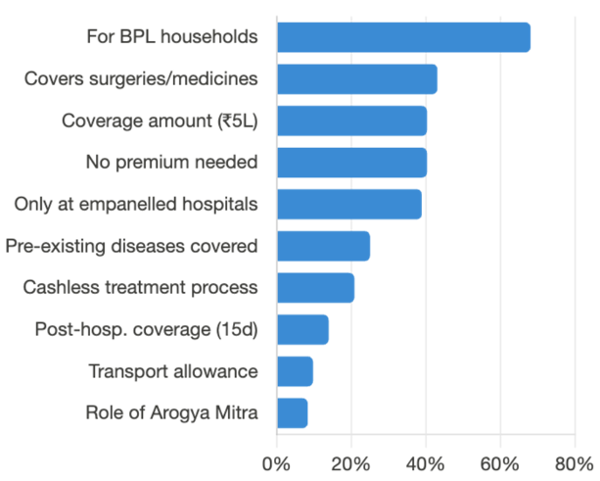
Of the 72 people who
had heard about the scheme not many knew about its
features (Figure 1). Only 25% knew that
pre-existing conditions were covered, while 20.8%
knew about cashless and paperless processing.
Fewer people (9.7%) knew about the transport
allowance, while only 8.3% knew about the Arogya
Mitra (scheme facilitator within empaneled
hospital). Nobody knew about the October 2024
Ayushman Vay Vandana initiative (inclusion of
elderly) or the March 2024 expansion of
eligibility to include the grassroots healthcare
workers (ASHA, Anganwadi workers) and their
families. This lack of awareness about eligibility
was also encountered among the community health
workers themselves.
|
| Figure 1: Knowledge of scheme
features among those aware of the national
scheme (N=72) (BPL= Below Poverty
Line; Arogya Mitra = Healthcare
friend/facilitator) |
Logistic regression
analysis revealed that education of the HoF (AOR =
9.20; 95% CI: 3.41–24.82; p < 0.001) and SC
caste status (AOR = 0.41; 95% CI: 0.19–0.89; p =
0.024) were independently significant predictors
of PMJAY awareness after controlling for
confounders (R² = 0.384).
Objective 2:
Utilisation patterns and barriers
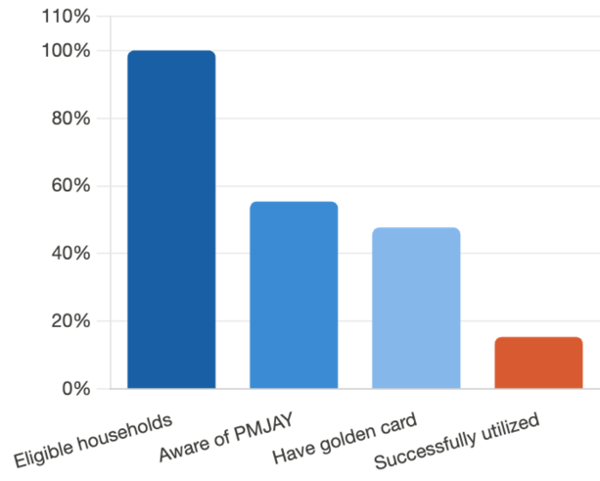
The scheme has been
implemented for over seven years now but only
47.7% of the people who are eligible received
their Ayushman golden card (Figure 2). Among the
respondents, 62 (47%) went to empanelled hospitals
and 68 (53%) went to non-empanelled private
hospitals. Only 15.4% of the respondents were able
to utilise the scheme, while 45% were refused
treatment even among the empaneled hospitals. One
person was turned away from a hospital on the
pretext that the hospital had already helped too
many people that month. Another person had to pay
all the money OOP because the person who was
supposed to help them in the hospital (Arogya
Mitra) was not there. A third person was asked to
pay some money and then get it back later but that
never happened. None of these respondents knew
about the grievance redressal mechanism.
|
| Figure
2: Utilisation patterns and barriers to
utilisation |
The most common
reason for non-utilisation of the scheme was
ignorance about empanelled hospitals (48.5% of
non-users), followed by the golden card
(beneficiary identity card) not yet having been
issued at the time of hospitalisation (22.1%),
prior negative experiences with empaneled
hospitals (10.3%), and distance to facility
(7.4%). Logistic regression analysis found card
possession (AOR = 14.7; 95% CI: 4.1–52.6; p
< 0.001) and awareness of empanelled
hospitals (AOR = 6.3; 95% CI: 2.2–18.1; p = 0.001)
were the strongest independent predictors of
utilisation (R² = 0.412).
|
Table 3: Hospital choice and
PMJAY scheme utilisation (N = 130)
|
|
Hospital Type
|
Total Patients
|
Used Golden Card
|
Card Use (%)
|
|
PMJAY Empaneled Public Hospital
|
41 (31.5%)
|
13
|
31.7
|
|
PMJAY Empaneled Private Hospital
|
21 (16.5%)
|
7
|
33.3
|
|
Non-Empaneled Private Hospital
|
68 (52%)
|
0
|
0.0
|
|
Total
|
130
|
20
|
15.4
|
As seen from Table
3, although all respondents (130) were eligible
for the scheme more than half (52%) did not seek
care in empanelled hospital. Only 20 (32%) among
the 62 respondents who had the beneficiary
identity card (golden card) to access the scheme
benefits, used it.
Objective 3:
Financial risk protection and catastrophic
health expenditure
The financial risk
protection among those who used the scheme is
shown in Table 4. Out of 20 people who
successfully used the scheme, the average direct
out-of-pocket expenses (OOPE) was Rs. 581.9 per
episode which was much lower than those who did
not avail the scheme (mean direct OOPE Rs.
13,355.8). However, among those who successfully
used the scheme, indirect costs averaged Rs. 2,650
per episode (more than four times the direct
costs). These indirect costs were mainly for
transport, food and lodging when they went to
district or urban empaneled hospitals. No one got
the transport allowance or reimbursement for
follow-up after hospitalisation that the scheme
promised. As a result, 75.0% of PMJAY users had
CHE when indirect costs were included (Table 4).
Among 68
non-empaneled hospital users, 95.6% had CHE on
combined costs. 30% of them had OOPE that was
more, than 100% of their monthly household
consumption expenditure. In this group, 20
households (29.4%) had to borrow money or sell
assets to pay for care. Among households that
borrowed, 55.0% sold jewellery or physical assets.
25.0% borrowed from family or friends and 20.0%
took loans from moneylenders. 50.0% of borrowing
households remained in debt at the time of data
collection. Logistic regression identified
non-utilisation of the scheme (AOR = 38.4; 95% CI:
9.2–160.7; p < 0.001) and illiteracy (AOR =
4.1; 95% CI: 1.4–12.2; p = 0.010) as independent
predictors of total CHE (R² = 0.468).
|
Table 4: Incidence of
catastrophic health expenditure (CHE)
and out-of-pocket expenditure (OOPE)
|
|
CHE Category
|
Empaneled Hospital Users (N=20)
|
Non-Empaneled Hospital Users
(N=68)
|
|
CHE from Direct Costs Only
|
0 (0.0%)
|
50 (73.5%)
|
|
CHE from Direct + Indirect Costs
|
15 (75.0%)
|
65 (95.6%)
|
|
No CHE Incurred
|
5 (25.0%)
|
3 (4.4%)
|
|
Mean Direct OOPE per episode (Rs.)
|
581.9
|
13,355.8
|
|
Mean Indirect OOPE per episode (Rs.)
|
2,650.0
|
3,852.9
|
|
Mean Total OOPE per episode (Rs.)
|
3,231.9
|
17,208.7
|
|
CHE threshold: OOPE > 10% of
monthly household consumption expenditure4.
|
Qualitative
findings from in-depth interviews
The following
thematic issues emerged from the analysis of
IDI’s.
Treatment
without dignity and informal payments:
Some people said they were treated poorly in
empaneled private hospitals with staff asking for
extra money for better care.
Non-Transparency
in expenditure information during
hospitalisation: None of the
respondents received a written summary or a
detailed bill when they were discharged from the
hospital. To know how much money is left on their
scheme card, people need to use the internet which
is hard for those who do not have internet access
or are digitally illiterate.
Minimal
Role of Arogya Mitras (Scheme facilitators in
hospitals): Most people said the
facilitators were not helpful or did not exist.
When someone had an emergency, the hospital asked
for a monetary deposit, which was promised to be
paid back but never returned.
Exclusion
of terminal conditions: Two
people said their family members with serious
diseases like kidney disease and blood cancer were
not allowed to get treatment under the scheme,
although the scheme includes these conditions.
Non-awareness
of scheme expansion: None of
the respondents knew about the scheme’s expansion
to include elderly and community healthcare
workers.
Discussion
This study analyses
the implementation of the AB-PMJAY scheme in one
of the poorest districts of India. The study shows
a gap between policy on paper and field level
implementation. Poor awareness of the scheme,
non-utilisation of the scheme (even among those
aware) and high indirect costs negatively affect
the intended financial risk protection of this
scheme. 55.4% of respondents in Nawada know about
PMJAY, which is slightly higher than what a
previous study[8] found (49.3%) in rural areas of
Bihar. This shows that more people know about
PMJAY now than they did in the past. Family or
friends were the most common source of information
about the scheme and not the community health
worker. This reveals a gap in the health system
implementation of this scheme because community
health workers are supposed to be spreading
awareness about this scheme. Moreover, many of the
community health workers were themselves unaware
of their eligibility for this scheme. Similar to
this study, other studies[9-11] have found low
education, lower caste and rural dwelling, as
significant factors negatively affecting awareness
and knowledge about the scheme benefits. Although
the scheme was expanded in March and later in
October 2024, with new awareness initiatives, it
failed to reach the rural poor in Nawada district.
The utilisation rate
of the scheme among those with the card at 32% is
very low and reflects the poor state of
implementation in the entire state of Bihar, which
has a very low card-to-admission ratio (2.2
percent). This is very different from states like
Tamil Nadu and Karnataka, where the utilisation
rate is much higher. Three reasons for this low
utilisation rate emerged from this study: lack of
awareness regarding empaneled hospitals; long
waiting time for getting the AB-PMJAY card; and
empanelled hospitals refusal to help. The high
refusal rate of hospitals (45%) reflects a lack of
regulatory oversight and compliance monitoring
over the private healthcare sector, resulting in
‘risky insurance’[12]. People have health
insurance but the hospitals do not follow the
rules. Empanelled hospitals refusal to hospitalise
eligible beneficiaries of the scheme is not
limited to Bihar state and has also been reported
in a pan-India study[13]. The National Health
Authority has a system to help people with their
grievances but low awareness affects its
implementation.
The study showed
that the scheme was effective in reducing direct
OOPE, among those who utilised it correctly (15%
of respondents). Studies done in other states[14]
and independent reports[5] also provide evidence
on the reduction in OOPE due to this scheme.
However, the high indirect costs experienced among
the scheme users is a major area of concern and
has been reported[15,16] in studies from other
states of India. Travel costs were significant
contributors to the indirect costs and although
the scheme provided for transport allowance, none
of the beneficiaries utilising the scheme in this
study received the transport allowance, which
reflects another implementation gap.
The findings of this
study can be interpreted using the theory of
planned behavior[17], which says that that people
are more likely to do something if they know about
it. If people do not know about the scheme (as in
this study) or if they have had bad experiences
with it before (also a finding from this study)
they are less likely to use it. Rogers[18], theory
of diffusion of innovations suggests that new
ideas and programs like AB-PMJAY are often adopted
slowly by people who are marginalised as is the
situation of the respondents of this study.
In terms of numbers,
national data shows that AB-PMJAY scheme has
distributed 435.2 million cards with 37,385
hospitals empaneled as part of the scheme. The
OOPE for health has come down from 55.63% when the
scheme started to the current value of 39.4%,
which is a significant achievement. The AB-PMJAY
2.0 reforms, which include AI based fraud
detection mechanisms, rationalized health benefit
package, upgraded Hospital Engagement Module and
creating a unified 14-digit health id for national
portability are all steps in the right direction.
However, as shown in this study the effectiveness
of this scheme lies in overcoming last mile
implementation hurdles.
Conclusions and
Recommendations
The implementation
issues identified in this study can be framed into
four dimensions of concern (4 A’s). These 4A’s
also serve as the four actionable areas for
recommendations.
Dimension 1:
Awareness
Only 55% of eligible
beneficiaries in this study were aware of the
scheme and none had information about all the
benefits of the scheme. Also, among those
enrolled, due to ignorance, less than half [62
(48%)] went to empanelled hospitals and among
these only 20 (32%) actually utilised the card to
access the scheme. Hence, enrolment in the scheme
or having the beneficiary identity card does not
in itself, equip beneficiaries with the
operational knowledge required for accessing the
scheme (knowledge about empanelled hospitals,
eligible services, benefits and rights).
Dimension 2:
Accessibility
In a rural district
like Nawada, the distribution of empanelled
hospitals is heavily skewed toward the district
headquarters and larger towns, leaving residents
of more distant rural villages without a
reasonably geographically accessible empanelled
facility. This study found that among those who
successfully used the scheme, indirect costs
averaged four times the direct costs. These
indirect costs were mainly for transport, food and
lodging when they went to district or urban
empaneled hospitals. Hence, the effectiveness of
the financial risk protection was negatively
affected.
Dimension 3:
Administrative
Non-issuance of
e-card among eligible beneficiaries,
non-reimbursement of transport expenses, absent or
non-helpful scheme facilitator in the empanelled
hospital, refusal of hospital to admit eligible
beneficiary, and informal payments reflect poor
administrative, regulatory and governance
mechanism.
Dimension 4:
Affordability
The study showed
that direct OOP payments were significantly lower
for those who utilised the scheme as compared to
those who did not utilise it. However, 75% of the
scheme beneficiaries experienced CHE due to
indirect costs suggesting that the schemes core
objective of financial risk protection was
negatively affected. Hence, the beneficiaries
faced a paradoxical situation of experiencing CHE
to access a scheme aimed at preventing OOPE.
Based on the 4 A’s
identified, the study recommends a strong offline
community awareness campaign by using existing
community health workers/local panchayat to
address the awareness concern. Development of
rural healthcare infrastructure should complement
expansion of the scheme as geographical location
of empanelled hospital is a significant
contributor to indirect costs in accessing the
scheme. Strong monitoring of empanelled hospitals
is required, while ensuring the presence of a
trained scheme facilitator in all empanelled
hospitals to improve the administrative bottle
necks in implementation. Locally based grievance
redressal mechanisms need to be made functional to
help patients in their time of need. All the above
steps, would help address the affordability
paradox in the scheme’s implementation.
Study limitations
The study is limited
to the beneficiary perspective and does not
include the provider perspective on this issue.
Since the recall period regarding hospitalisation
experience was one year, it is subject to recall
bias/error.
References
- World Bank. World development indicators:
Health expenditure data. World Bank DataBank;
2025. Available from: https://databank.worldbank.org
- Ministry of Health and Family Welfare,
Government of India. Health benefit package
under PM-JAY: Revised 2025 list of 1,961
procedures. National Health Authority; 2025.
Available from: https://pmjay.gov.in
- Bhatnagar A, Chhabra P, Singh S, Banerjee S.
Coverage and utilization of Pradhan Mantri Jan
Arogya Yojana (PM-JAY) across Indian states:
Findings from the National Family Health
Survey-5. Lancet Reg Health Southeast Asia.
2022;3:100017. doi: 10.1016/j.lansea.2022.100017
- Medical Buyer. Bihar PM-JAY: State-wise
hospitalization and card issuance data, October
2024. Medical Buyer India; 2024. Available from:
https://www.medicalbuyerindia.com
- Drishti IAS. Ayushman Bharat Pradhan Mantri
Jan Arogya Yojana (AB-PM-JAY); 2025. Available
from: https://www.drishtiias.com/to-the-points/paper2/ayushman-bharat-pradhan-mantri-jan-arogya-yojana
- Wagstaff A, van Doorslaer E. Catastrophe and
impoverishment in paying for health care: With
applications to Vietnam 1993–1998. Health
Econ. 2003;12(11):921–934. doi:
10.1002/hec.776
- Braun V, Clarke V. Using thematic analysis in
psychology. Qual Res Psychol. 2006;3(2):77–101.
doi: 10.1191/1478088706qp063oa
- Prasad V, Singh S, Kumar P. PMJAY awareness
and utilization in rural Bihar: A
cross-sectional study. J Family Med Primary
Care. 2023;12(5):987–993.
- Thomas A, Murthy S, Bhattacharya A.
Determinants of PMJAY awareness, enrolment, and
utilization: Evidence from six Indian states. Health
Policy Plan. 2023;38(6):645–657. doi:
10.1093/heapol/czad034
- Patel R, Bhimani D. Awareness of Ayushman
Bharat PM-JAY among eligible beneficiaries in
Gujarat. Indian J Public Health. 2025;69(1):78–84.
- Dixit R, Chauhan A, Juneja K. Awareness and
Utilization of Ayushman Bharat Pradhan Mantri
Jan Arogya Yojana (AB-NHPM) among Beneficiaries
of Gautam Buddha Nagar District: A Comparative
Study. Indian J Community Med. 2025;50(1):213-219.
doi: 10.4103/ijcm.ijcm_728_23
- Agnes N. Risky insurance: The Pradhan Mantri
Jan Arogya Yojana in Jharkhand. Econ Polit
Wkly. 2020;55(45). Available from: https://www.epw.in/journal/2020/45/reports-states/risky-insurance.html
- Trivedi M, Patel S, Sharma R. User experiences
and access barriers under PMJAY: A national
qualitative study. PLOS ONE. 2022;17(4):e0266732.
doi: 10.1371/journal.pone.0266732
- Kumar R, Sharma P, Gupta M. Reduction in
catastrophic health expenditure under AB-PMJAY
at a tertiary hospital in Himachal Pradesh. Indian
J Community Med. 2024;49(2):234–239.
- Garg S, Tripathy JP, Roy A, Bhattacharyya K.
Four-year impact evaluation of Ayushman Bharat
PMJAY in Chhattisgarh. BMC Health Serv Res.
2024;24(1):312. doi:
10.1186/s12913-024-10812-y
- Parmar D, Williams G, Dkhimi F, Ndiaye A,
Asante FA, Arhinful DK, Mladovsky P. Enrolment
of older people in social health protection
programs in West Africa: Does social exclusion
play a part? Health Syst Reform. 2023;9(1):e2198040.
doi: 10.1080/23288604.2023.2198040
- Ajzen I. The theory of planned behavior. Organ
Behav Hum Decis Process. 1991;50(2):179–211.
doi: 10.1016/0749-5978(91)90020-T
- Rogers EM. Diffusion of innovations. Free
Press. 1962.
|


